Crumpled Crater
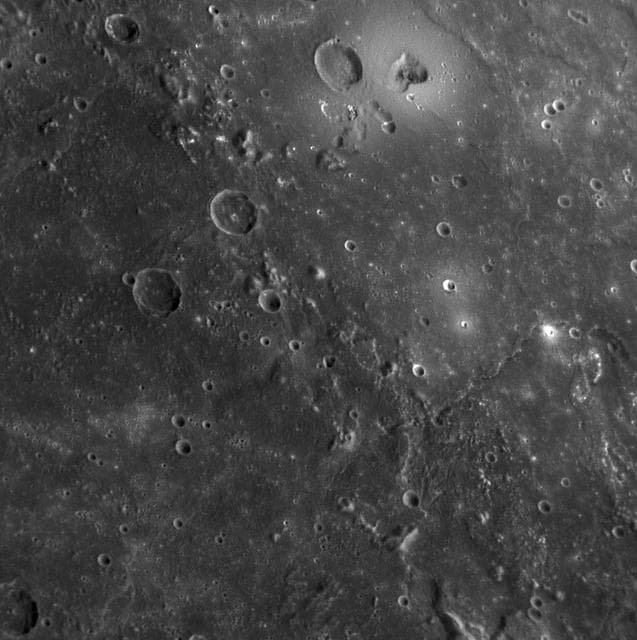
It is no secret that Mercury's surface is scarred by abundant tectonic deformation, the vast majority of which is due to the planet's history of cooling and contraction through time. Yet Mercury is also heavily cratered, and hosts widespread volcanic plains. So it's perhaps unsurprising that these three types of landform often intersect-literally-as shown in this scene. Here, an unnamed crater, about 7.5 km (4.7 mi.) in diameter was covered, and almost fully buried, by lava. At some point after, compression of the surface formed scarps and ridges in the area that, when they reached the buried crater, came to describe its curved outline. Many arcuate ridges on Mercury formed this way. In this high-resolution view, we can also see the younger, later population of smaller craters that pock-mark the surface. http://photojournal.jpl.nasa.gov/catalog/PIA19263
Usage Rights
Most NASA images are in the public domain and free to use. Credit NASA as the source. Check NASA's media usage guidelines for details. Images featuring identifiable individuals may require additional permissions.
Details
NASA ID
PIA19263
Date Created
March 30, 2015
Center
JPL
Media Type
image
Downloads
Download this image in multiple resolutions. All NASA media are free for public use.