Smooth Slopes
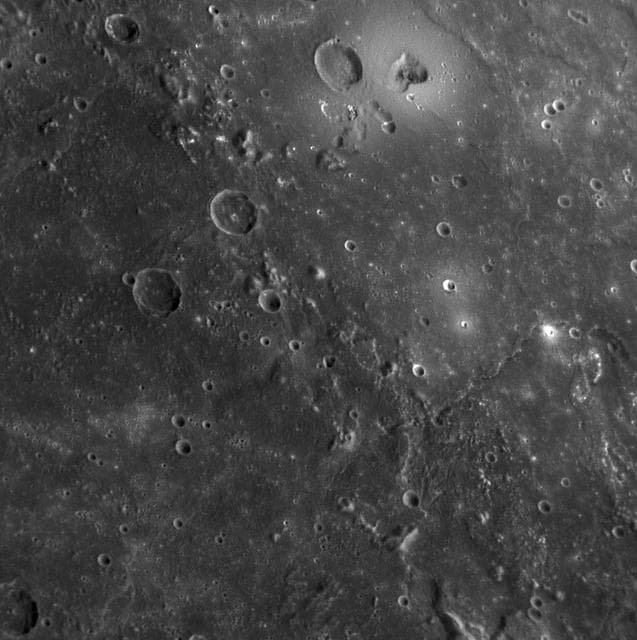
The region with fewer impact craters in the bottom-right corner of this image is a small portion of the peak ring of an ancient basin over 200 km in diameter. The peak has fewer superposed impact craters, which could lead to the conclusion that it is younger than the surrounding basin floor. However, the lack of craters is instead due to the steeper slopes of the peak, where impact craters are not preserved as long. This image was acquired as part of the MDIS low-altitude imaging campaign. During MESSENGER's second extended mission, the spacecraft makes a progressively closer approach to Mercury's surface than at any previous point in the mission, enabling the acquisition of high-spatial-resolution data. For spacecraft altitudes below 350 kilometers, NAC images are acquired with pixel scales ranging from 20 meters to as little as 2 meters. http://photojournal.jpl.nasa.gov/catalog/PIA19203
Usage Rights
Most NASA images are in the public domain and free to use. Credit NASA as the source. Check NASA's media usage guidelines for details. Images featuring identifiable individuals may require additional permissions.
Details
NASA ID
PIA19203
Date Created
February 13, 2015
Center
JPL
Media Type
image
Downloads
Download this image in multiple resolutions. All NASA media are free for public use.