Big Boulders
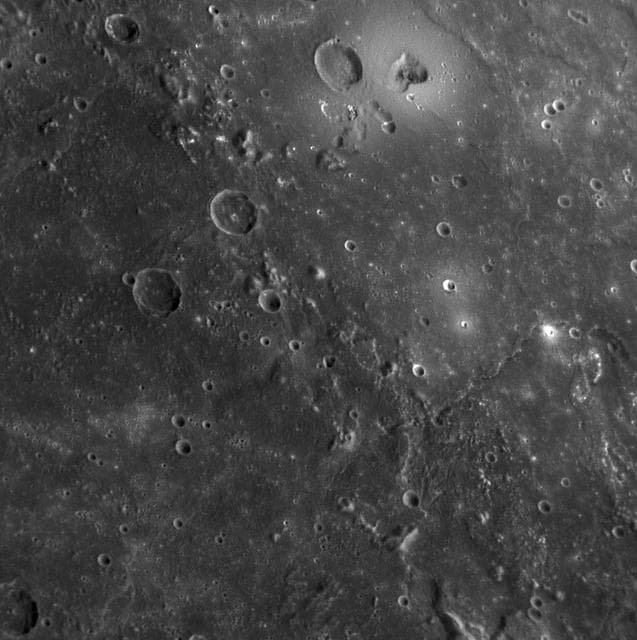
On Mercury, craters larger than approximately 10-12 km display a complex morphology, with slump terraces and central peaks, as compared to smaller bowl-shaped craters. At this complex crater, nearly 20 km in diameter, boulders created by the impact event can be seen outside the southwest rim and within the crater interior. The largest boulder observed here is around 180 m (590 feet) across! For comparison with humans for scale, check out the lunar House Rock at the Apollo 16 site, which is (only) 24 meters across. Date acquired: January 24, 2015 Image Mission Elapsed Time (MET): 64441328 Image ID: 7855678 Instrument: Narrow Angle Camera (NAC) of the Mercury Dual Imaging System (MDIS) Center Latitude: -2.66° Center Longitude: 83.54° E Resolution: 26 meters/pixel Scale: This crater is approximately 19.5 km (12.1 miles) in diameter Incidence Angle: 82.8° Emission Angle: 43.0° Phase Angle: 39.8° http://photojournal.jpl.nasa.gov/catalog/PIA19202
Usage Rights
Most NASA images are in the public domain and free to use. Credit NASA as the source. Check NASA's media usage guidelines for details. Images featuring identifiable individuals may require additional permissions.
Details
NASA ID
PIA19202
Date Created
February 11, 2015
Center
JPL
Media Type
image
Downloads
Download this image in multiple resolutions. All NASA media are free for public use.