Entranced by a Transit
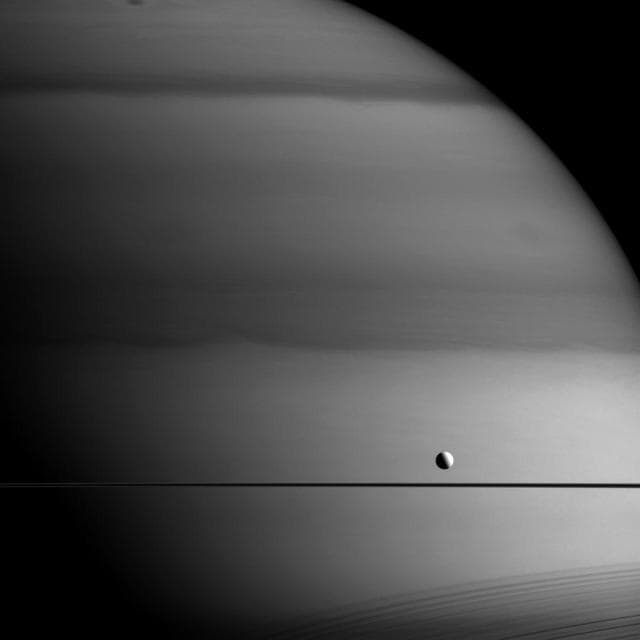
Saturn's moon Dione crosses the face of the giant planet in this view, a phenomenon astronomers call a transit. Transits play an important role in astronomy and can be used to study the orbits of planets and their atmospheres, both in our solar system and in others. By carefully timing and observing transits in the Saturn system, like that of Dione (698 miles or 1123 kilometers across), scientists can more precisely determine the orbital parameters of Saturn's moons. This view looks toward the unilluminated side of the rings from about 0.3 degrees below the ring plane. The image was taken in visible green light with the Cassini spacecraft narrow-angle camera on May 21, 2015. The view was acquired at a distance of approximately 1.4 million miles (2.3 million kilometers) from Saturn and at a Sun-Saturn-spacecraft, or phase, angle of 119 degrees. Image scale is 9 miles (14 kilometers) per pixel. http://photojournal.jpl.nasa.gov/catalog/PIA18330
Usage Rights
Most NASA images are in the public domain and free to use. Credit NASA as the source. Check NASA's media usage guidelines for details. Images featuring identifiable individuals may require additional permissions.
Keywords
Details
NASA ID
PIA18330
Date Created
August 31, 2015
Center
JPL
Media Type
image
Downloads
Download this image in multiple resolutions. All NASA media are free for public use.