Bright Basin on Tethys
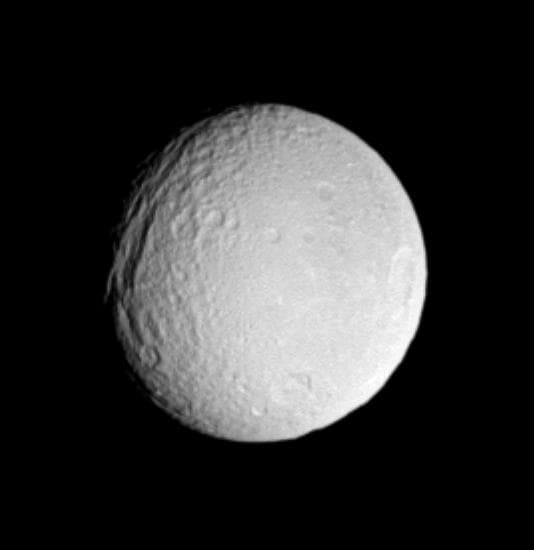
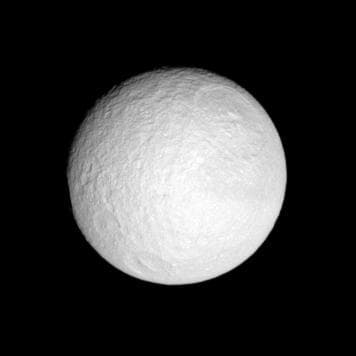
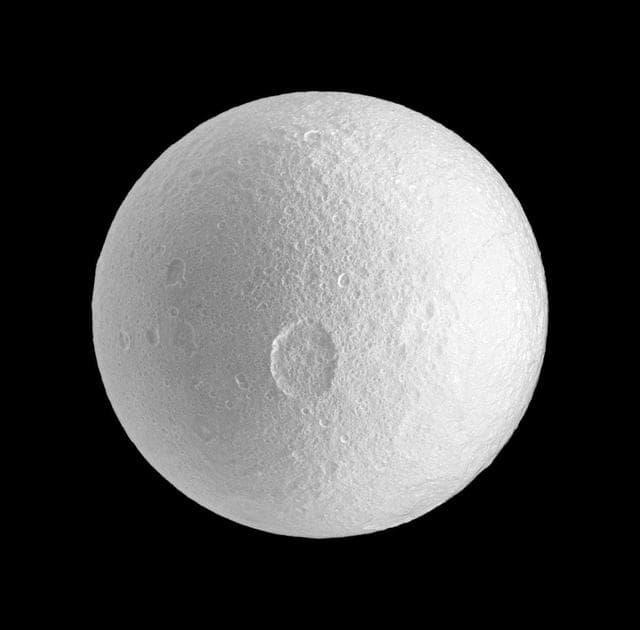
With the expanded range of colors visible to Cassini's cameras, differences in materials and their textures become apparent that are subtle or unseen in natural color views. Here, the giant impact basin Odysseus on Saturn's moon Tethys stands out brightly from the rest of the illuminated icy crescent. This distinct coloration may result from differences in either the composition or structure of the terrain exposed by the giant impact. Odysseus (280 miles, or 450 kilometers, across) is one of the largest impact craters on Saturn's icy moons, and may have significantly altered the geologic history of Tethys. Tethys' dark side (at right) is faintly illuminated by reflected light from Saturn. Images taken using ultraviolet, green and infrared spectral filters were combined to create this color view. North on Tethys (660 miles or 1,062 kilometers across) is up in this view. The view was acquired on May 9, 2015 at a distance of approximately 186,000 miles (300,000 kilometers) from Tethys. Image scale is 1.1 mile (1.8 kilometers) per pixel. http://photojournal.jpl.nasa.gov/catalog/PIA18329
Usage Rights
Most NASA images are in the public domain and free to use. Credit NASA as the source. Check NASA's media usage guidelines for details. Images featuring identifiable individuals may require additional permissions.
Keywords
Details
NASA ID
PIA18329
Date Created
July 27, 2015
Center
JPL
Media Type
image
Downloads
Download this image in multiple resolutions. All NASA media are free for public use.