Tethys Eyes Saturn
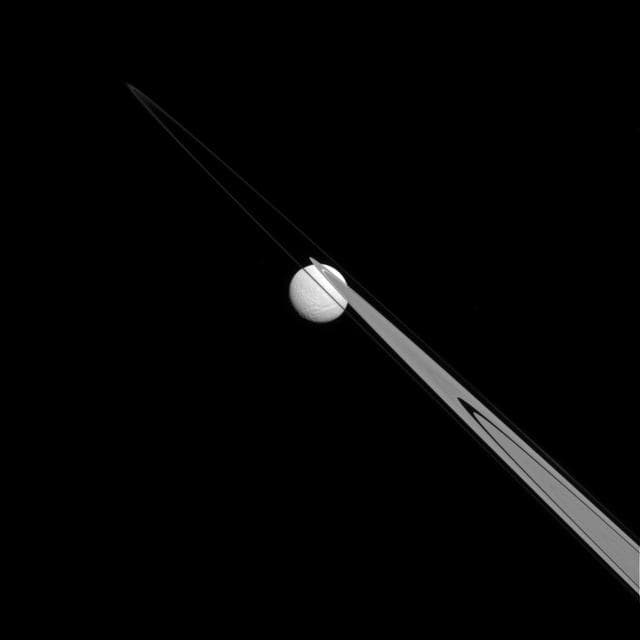
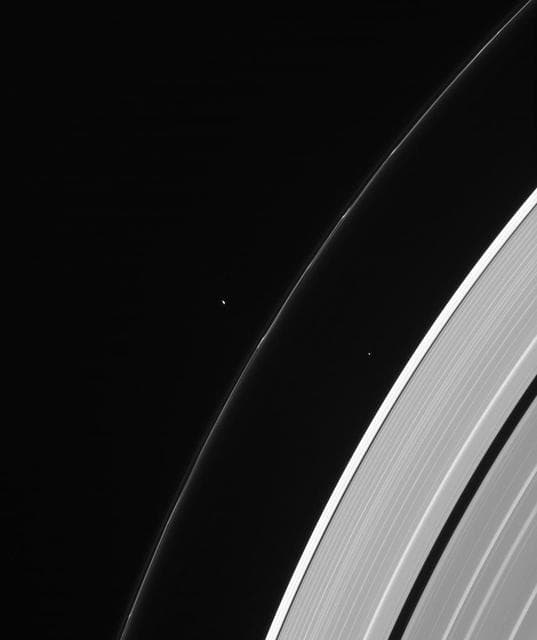
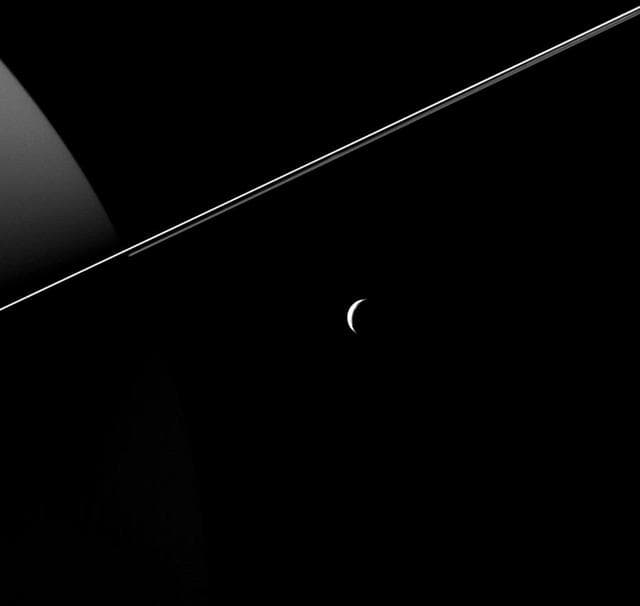
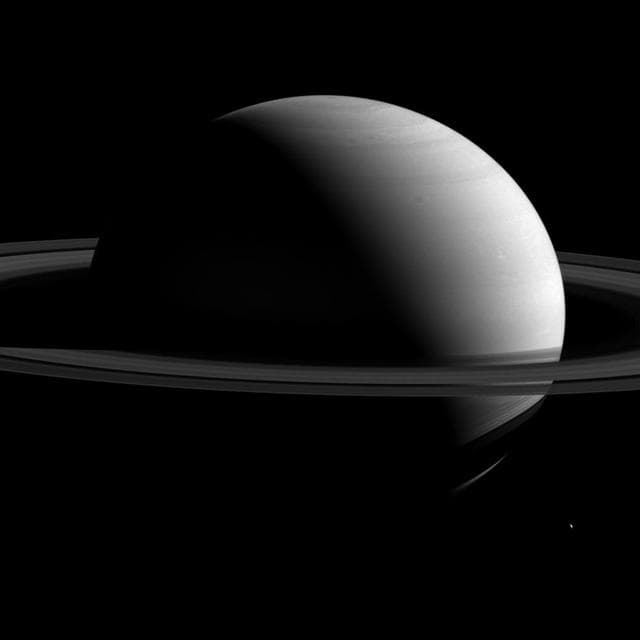
The two large craters on Tethys, near the line where day fades to night, almost resemble two giant eyes observing Saturn. The location of these craters on Tethys' terminator throws their topography into sharp relief. Both are large craters, but the larger and southernmost of the two shows a more complex structure. The angle of the lighting highlights a central peak in this crater. Central peaks are the result of the surface reacting to the violent post-impact excavation of the crater. The northern crater does not show a similar feature. Possibly the impact was too small to form a central peak, or the composition of the material in the immediate vicinity couldn't support the formation of a central peak. In this image Tethys is significantly closer to the camera, while the planet is in the background. Yet the moon is still utterly dwarfed by the giant Saturn. This view looks toward the anti-Saturn side of Tethys. North on Tethys is up and rotated 42 degrees to the right. The image was taken in visible light with the Cassini spacecraft wide-angle camera on April 11, 2015. The view was obtained at a distance of approximately 75,000 miles (120,000 kilometers) from Tethys. Image scale at Tethys is 4 miles (7 kilometers) per pixel. http://photojournal.jpl.nasa.gov/catalog/pia18318
Usage Rights
Most NASA images are in the public domain and free to use. Credit NASA as the source. Check NASA's media usage guidelines for details. Images featuring identifiable individuals may require additional permissions.
Keywords
Details
NASA ID
PIA18318
Date Created
June 15, 2015
Center
JPL
Media Type
image
Downloads
Download this image in multiple resolutions. All NASA media are free for public use.