Mimicking the Moon
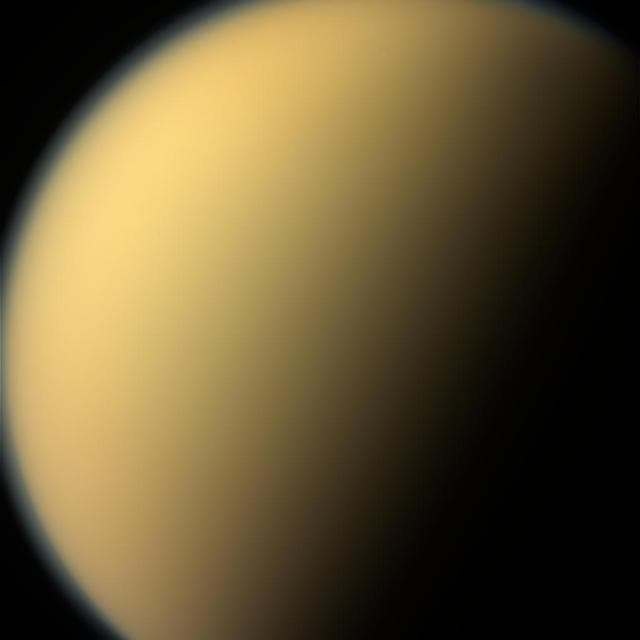
When Galileo first observed Venus displaying a crescent phase, he excitedly wrote to Kepler (in anagram) of Venus mimicking the moon-goddess. He would have been delirious with joy to see Saturn and Titan, seen in this image, doing the same thing. More than just pretty pictures, high-phase observations -- taken looking generally toward the Sun, as in this image -- are very powerful scientifically since the way atmospheres and rings transmit sunlight is often diagnostic of compositions and physical states. In this example, Titan's crescent nearly encircles its disk due to the small haze particles high in its atmosphere refracting the incoming light of the distant Sun. This view looks toward the sunlit side of the rings from about 3 degrees above the ringplane. The image was taken in violet light with the Cassini spacecraft wide-angle camera on Aug. 11, 2013. The view was obtained at a distance of approximately 1.1 million miles (1.7 million kilometers) from Saturn and at a Sun-Saturn-spacecraft, or phase, angle of 154 degrees. Image scale is 64 miles (103 kilometers) per pixel. http://photojournal.jpl.nasa.gov/catalog/PIA18291
Usage Rights
Most NASA images are in the public domain and free to use. Credit NASA as the source. Check NASA's media usage guidelines for details. Images featuring identifiable individuals may require additional permissions.
Keywords
Details
NASA ID
PIA18291
Date Created
November 3, 2014
Center
JPL
Media Type
image
Downloads
Download this image in multiple resolutions. All NASA media are free for public use.