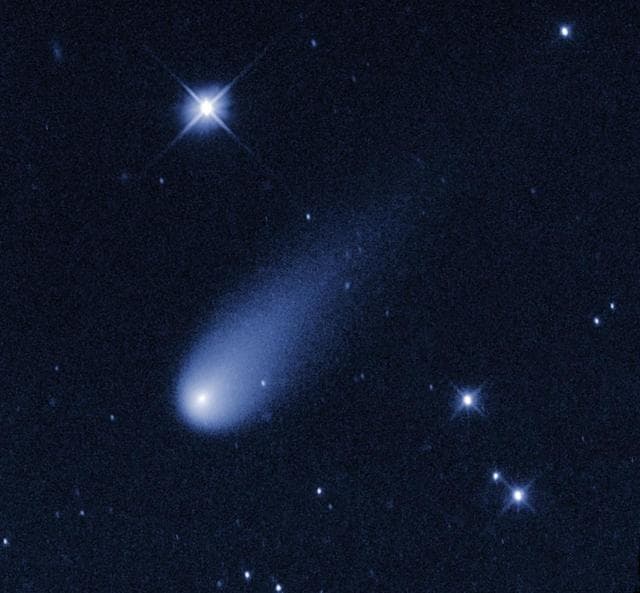
NASA Hubble Sees Comet ISON Intact
This image from NASA Hubble Space Telescope of the sunward plunging comet ISON suggests that the comet is intact despite some predictions that the fragile icy nucleus might disintegrate as the sun warms it. In this NASA Hubble Space Telescope image taken on October 9, 2013 the comet's solid nucleus is unresolved because it is so small. If the nucleus broke apart then Hubble would have likely seen evidence for multiple fragments. Moreover, the coma or head surrounding the comet's nucleus is symmetric and smooth. This would probably not be the case if clusters of smaller fragments were flying along. What's more, a polar jet of dust first seen in Hubble images taken in April is no longer visible and may have turned off. This color composite image was assembled using two filters. The comet's coma appears cyan, a greenish-blue color due to gas, while the tail is reddish due to dust streaming off the nucleus. The tail forms as dust particles are pushed away from the nucleus by the pressure of sunlight. The comet was inside Mars' orbit and 177 million miles from Earth when photographed. Comet ISON is predicted to make its closest approach to Earth on 26 December, at a distance of 39.9 million miles. http://photojournal.jpl.nasa.gov/catalog/PIA18153
Usage Rights
Most NASA images are in the public domain and free to use. Credit NASA as the source. Check NASA's media usage guidelines for details. Images featuring identifiable individuals may require additional permissions.
Keywords
Details
NASA ID
PIA18153
Date Created
October 9, 2013
Center
JPL
Media Type
image
Downloads
Download this image in multiple resolutions. All NASA media are free for public use.