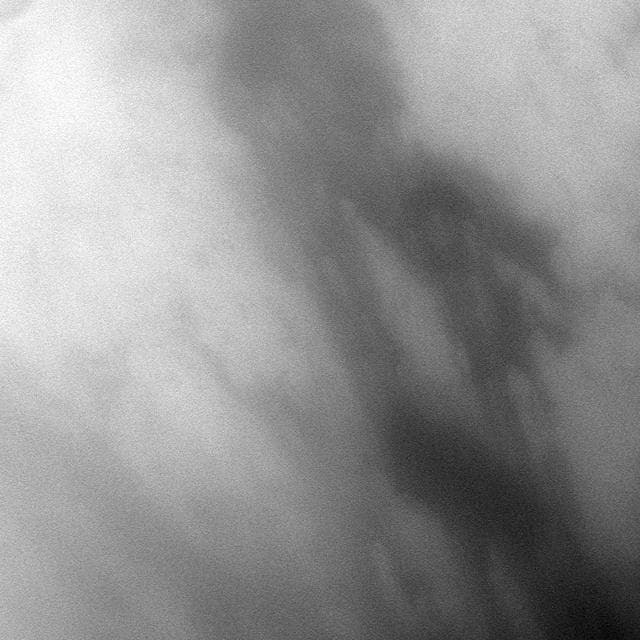
Titan Lingering Clouds
Lots of clouds are visible in this infrared image of Saturn's moon Titan. These clouds form and move much like those on Earth, but in a much slower, more lingering fashion, new results from NASA's Cassini spacecraft show. Scientists have monitored Titan's atmosphere for three-and-a-half years, between July 2004 and December 2007, and observed more than 200 clouds. The way these clouds are distributed around Titan matches scientists' global circulation models. The only exception is timing—clouds are still noticeable in the southern hemisphere while fall is approaching. Three false-color images make up this mosaic and show the clouds at 40 to 50 degrees mid-latitude. The images were taken by Cassini's visual and infrared mapping spectrometer during a close flyby of Titan on Sept. 7, 2006, known as T17. For a similar view see PIA12005. Each image is a color composite, with red shown at the 2-micron wavelength, green at 1.6 microns, and blue at 2.8 microns. An infrared color mosaic is also used as a background (red at 5 microns, green at 2 microns and blue at 1.3 microns). The characteristic elongated mid-latitude clouds, which are easily visible in bright bluish tones are still active even late into 2006-2007. According to climate models, these clouds should have faded out since 2005. http://photojournal.jpl.nasa.gov/catalog/PIA12004
Usage Rights
Most NASA images are in the public domain and free to use. Credit NASA as the source. Check NASA's media usage guidelines for details. Images featuring identifiable individuals may require additional permissions.
Keywords
Details
NASA ID
PIA12004
Date Created
June 3, 2009
Center
JPL
Media Type
image
Downloads
Download this image in multiple resolutions. All NASA media are free for public use.