Why Are Galaxies So Smooth?
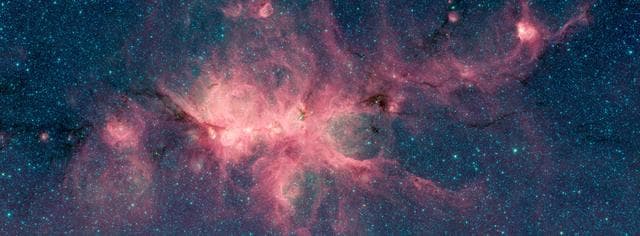
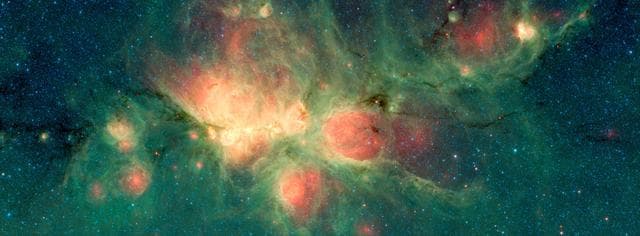
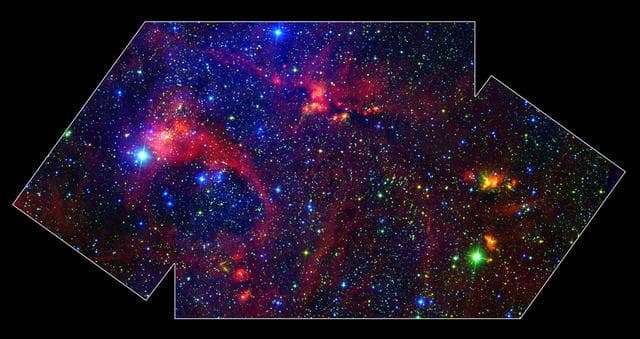
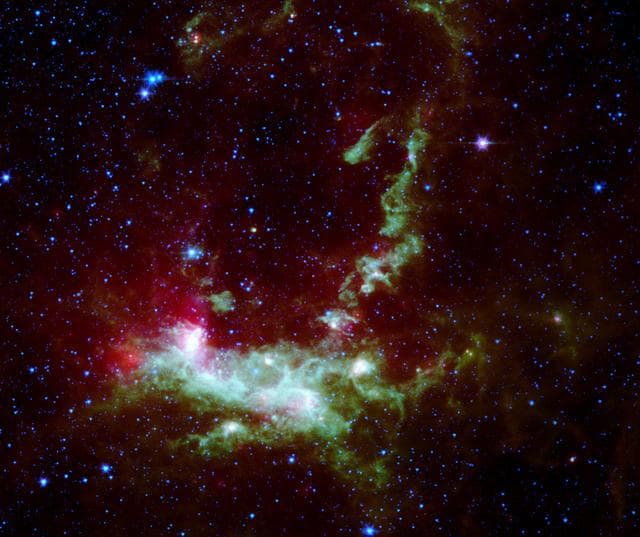
This image from NASA's Spitzer Space Telescope shows the spiral galaxy NGC 2841, located about 46 million light-years from Earth in the constellation Ursa Major. The galaxy is helping astronomers solve one of the oldest puzzles in astronomy: Why do galaxies look so smooth, with stars sprinkled evenly throughout? An international team of astronomers has discovered that rivers of young stars flow from their hot, dense stellar nurseries, dispersing out to form large, smooth distributions. This image is a composite of three different wavelengths from Spitzer's infrared array camera. The shortest wavelengths are displayed inblue, and mostly show the older stars in NGC 2841, as well as foreground stars in our own Milky Way galaxy. The cooler areas are highlighted in red, and show the dusty, gaseous regions of the galaxy. Blue shows infrared light of 3.6 microns, green represents 4.5-micron light and red, 8.0-micron light. The contribution from starlight measured at 3.6 microns has been subtracted from the 8.0-micron data to enhance the visibility of the dust features.The shortest wavelengths are displayed inblue, and mostly show the older stars in NGC 2841, as well as foreground stars in our own Milky Way galaxy. http://photojournal.jpl.nasa.gov/catalog/PIA12001
Usage Rights
Most NASA images are in the public domain and free to use. Credit NASA as the source. Check NASA's media usage guidelines for details. Images featuring identifiable individuals may require additional permissions.
Details
NASA ID
PIA12001
Date Created
April 30, 2009
Center
JPL
Media Type
image
Downloads
Download this image in multiple resolutions. All NASA media are free for public use.