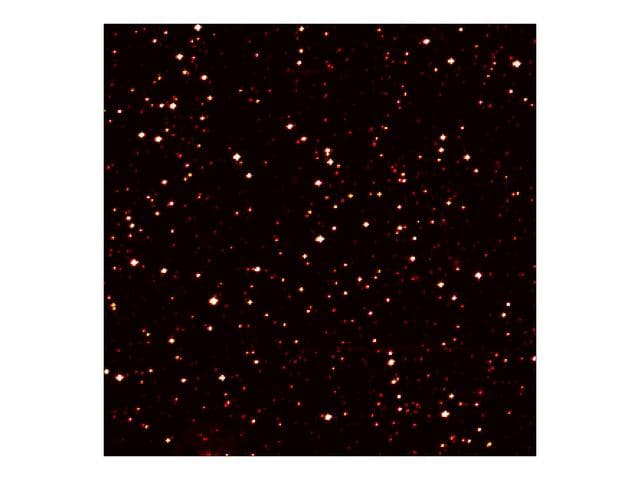
Cluster of Stars in Kepler Sight
This image zooms into a small portion of NASA Kepler full field of view, an expansive, 100-square-degree patch of sky in our Milky Way galaxy. An eight-billion-year-old cluster of stars 13,000 light-years from Earth, called NGC 6791, can be seen in the image. Clusters are families of stars that form together out of the same gas cloud. This particular cluster is called an open cluster, because the stars are loosely bound and have started to spread out from each other. The area pictured is 0.2 percent of Kepler's full field of view, and shows hundreds of stars in the constellation Lyra. The image has been color-coded so that brighter stars appear white, and fainter stars, red. It is a 60-second exposure, taken on April 8, 2009, one day after the spacecraft's dust cover was jettisoned. Kepler was designed to hunt for planets like Earth. The mission will spend the next three-and-a-half years staring at the same stars, looking for periodic dips in brightness. Such dips occur when planets cross in front of their stars from our point of view in the galaxy, partially blocking the starlight. To achieve the level of precision needed to spot planets as small as Earth, Kepler's images are intentionally blurred slightly. This minimizes the number of saturated stars. Saturation, or "blooming," occurs when the brightest stars overload the individual pixels in the detectors, causing the signal to spill out into nearby pixels. http://photojournal.jpl.nasa.gov/catalog/PIA11986
Usage Rights
Most NASA images are in the public domain and free to use. Credit NASA as the source. Check NASA's media usage guidelines for details. Images featuring identifiable individuals may require additional permissions.
Details
NASA ID
PIA11986
Date Created
April 16, 2009
Center
JPL
Media Type
image
Downloads
Download this image in multiple resolutions. All NASA media are free for public use.