Raining Rocks
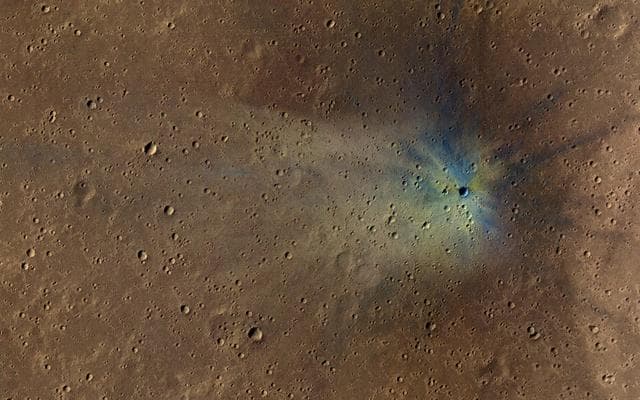
Impact ejecta is material that is thrown up and out of the surface of a planet as a result of the impact of an meteorite, asteroid or comet. The material that was originally beneath the surface of the planet then rains down onto the environs of the newly formed impact crater. Some of this material is deposited close to the crater, folding over itself to form the crater rim, visible here as a yellowish ring. Other material is ejected faster and falls down further from the crater rim creating two types of ejecta: a "continuous ejecta blanket" and "discontinuous ejecta." Both are shown in this image. The blocky area at the center of the image close to the yellowish crater rim is the "continuous" ejecta. The discontinuous ejecta is further from the crater rim, streaking away from the crater like spokes on a bicycle. (Note: North is to the right.) http://photojournal.jpl.nasa.gov/catalog/PIA11180
Usage Rights
Most NASA images are in the public domain and free to use. Credit NASA as the source. Check NASA's media usage guidelines for details. Images featuring identifiable individuals may require additional permissions.
Details
NASA ID
PIA11180
Date Created
February 1, 2017
Center
JPL
Media Type
image
Downloads
Download this image in multiple resolutions. All NASA media are free for public use.