Rough and Tumble Hyperion Movie
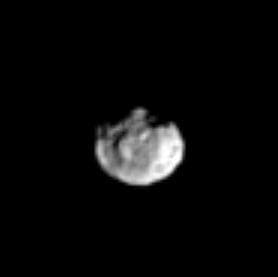
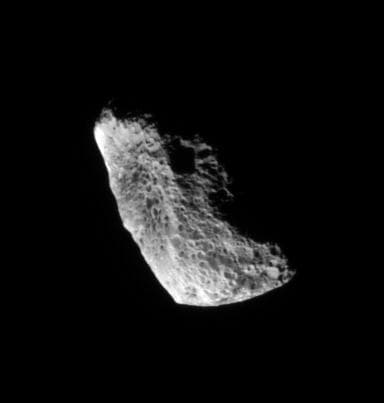
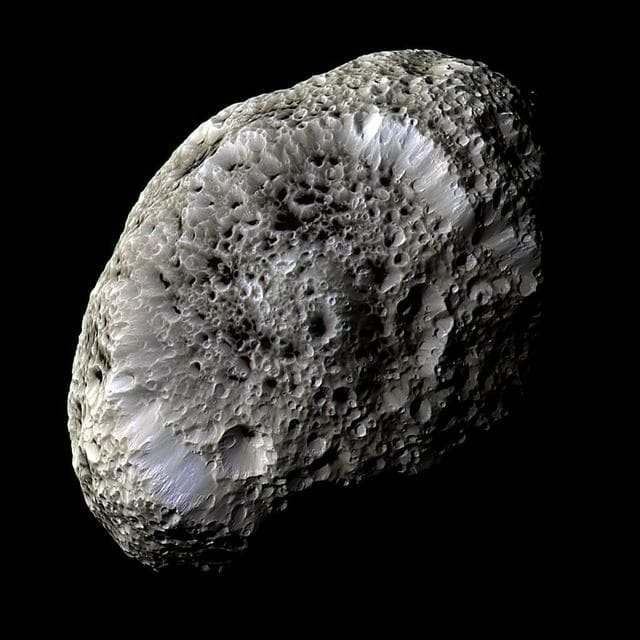
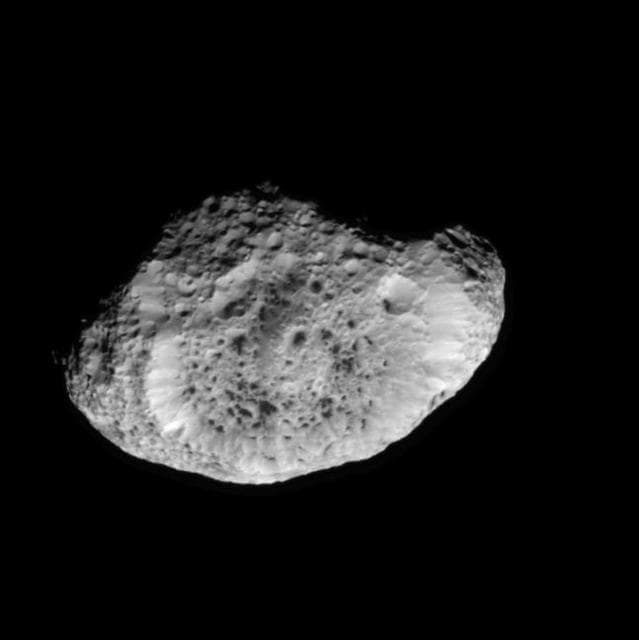
The tumbling and irregularly shaped moon Hyperion rotates away from the Cassini spacecraft in this movie taken during a distant encounter in Dec. 2005. A shadow closes over the large crater at bottom as the movie progresses. Hyperion (280 kilometers, or 174 miles across) is covered with closely packed and deeply etched pits. The warming action of the Sun on water ice lying beneath a darkened layer of surface material apparently has deepened and exaggerated the depressions already created by impacts. Cassini scientists now think that Hyperion’s unusual appearance can be attributed to the fact that it has an unusually low density for such a large object, giving it weak surface gravity and high porosity. These characteristics help preserve the original shapes of Hyperion’s craters by limiting the amount of impact ejecta coating the moon’s surface. Impactors tend to make craters by compressing the surface material, rather than blasting it out. Further, Hyperion’s weak gravity, and correspondingly low escape velocity, means that what little ejecta is produced has a good chance of escaping the moon altogether. The images were taken in visible light with the Cassini spacecraft narrow-angle camera on Dec. 23, 2005 at distances ranging from 228,000 kilometers (142,000 miles) to 238,000 kilometers (148,000 miles) from Hyperion and at a Sun-Hyperion-spacecraft, or phase, angle ranging from 77 to 86 degrees. Resolution in the original images was about 1.4 kilometers (0.9 mile) per pixel. The images have been magnified by a factor of two and contrast-enhanced to aid visibility. An animation is available at http://photojournal.jpl.nasa.gov/catalog/PIA07683
Usage Rights
Most NASA images are in the public domain and free to use. Credit NASA as the source. Check NASA's media usage guidelines for details. Images featuring identifiable individuals may require additional permissions.
Keywords
Details
NASA ID
PIA07683
Date Created
February 3, 2006
Center
JPL
Media Type
image
Downloads
Download this image in multiple resolutions. All NASA media are free for public use.