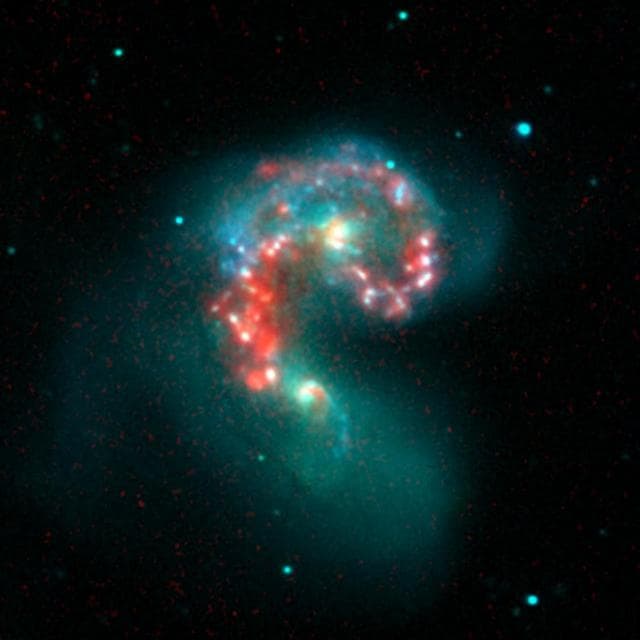
Life at the Intersection of Colliding Galaxies
This false-color image from NASA's Spitzer Space Telescope reveals hidden populations of newborn stars at the heart of the colliding "Antennae" galaxies. These two galaxies, known individually as NGC 4038 and 4039, are located around 68 million light-years away and have been merging together for about the last 800 million years. The latest Spitzer observations provide a snapshot of the tremendous burst of star formation triggered in the process of this collision, particularly at the site where the two galaxies overlap. The image was taken by Spitzer's infrared array camera and is a combination of infrared light ranging from 3.6 microns (shown in blue) to 8.0 microns (shown in red). The dust emission (red) is by far the strongest feature in this image. Starlight was systematically subtracted from the longer wavelength data (red) to enhance dust features. The two nuclei, or centers, of the merging galaxies show up as white areas, one above the other. The brightest clouds of forming stars lie in the overlap region between and left of the nuclei. Throughout the sky, astronomers have identified many of these so-called "interacting" galaxies, whose spiral discs have been stretched and distorted by their mutual gravity as they pass close to one another. The distances involved are so large that the interactions evolve on timescales comparable to geologic changes on Earth. Observations of such galaxies, combined with computer models of these collisions, show that the galaxies often become forever bound to one another, eventually merging into a single, spheroidal-shaped galaxy. Wavelengths of 3.6 microns are represented in blue, 4.5 microns in green and 5.8-8.0 microns in red. This image was taken on Dec. 24, 2003. http://photojournal.jpl.nasa.gov/catalog/PIA06853
Usage Rights
Most NASA images are in the public domain and free to use. Credit NASA as the source. Check NASA's media usage guidelines for details. Images featuring identifiable individuals may require additional permissions.
Details
NASA ID
PIA06853
Date Created
September 7, 2004
Center
JPL
Media Type
image
Downloads
Download this image in multiple resolutions. All NASA media are free for public use.