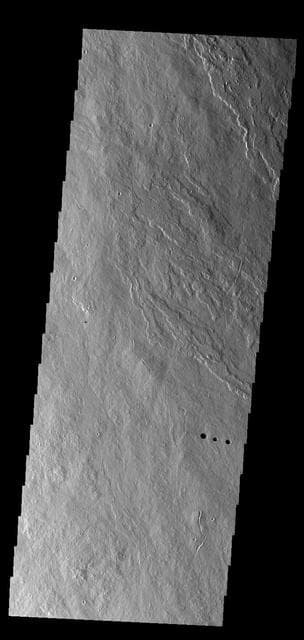
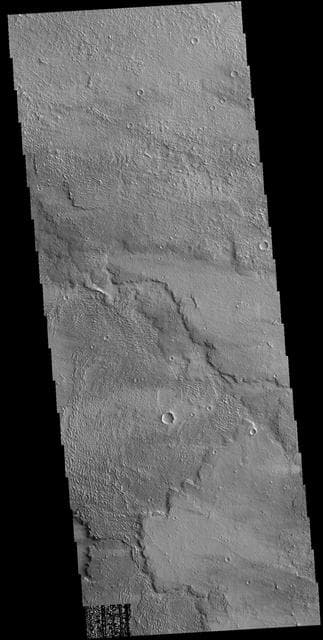
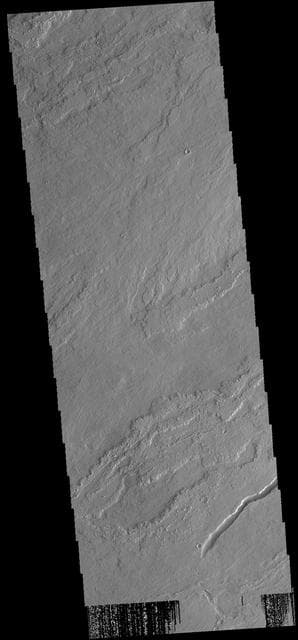
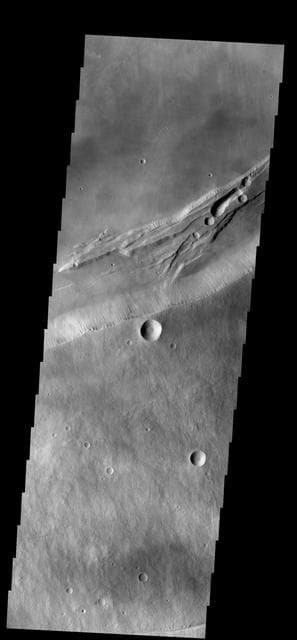
Arsia Mons by Day and Night
Released 22 June 2004 This pair of images shows part of Arsia Mons. Day/Night Infrared Pairs The image pairs presented focus on a single surface feature as seen in both the daytime and nighttime by the infrared THEMIS camera. The nighttime image (right) has been rotated 180 degrees to place north at the top. Infrared image interpretation Daytime: Infrared images taken during the daytime exhibit both the morphological and thermophysical properties of the surface of Mars. Morphologic details are visible due to the effect of sun-facing slopes receiving more energy than antisun-facing slopes. This creates a warm (bright) slope and cool (dark) slope appearance that mimics the light and shadows of a visible wavelength image. Thermophysical properties are seen in that dust heats up more quickly than rocks. Thus dusty areas are bright and rocky areas are dark. Nighttime: Infrared images taken during the nighttime exhibit only the thermophysical properties of the surface of Mars. The effect of sun-facing versus non-sun-facing energy dissipates quickly at night. Thermophysical effects dominate as different surfaces cool at different rates through the nighttime hours. Rocks cool slowly, and are therefore relatively bright at night (remember that rocks are dark during the day). Dust and other fine grained materials cool very quickly and are dark in nighttime infrared images. Image information: IR instrument. Latitude -19.6, Longitude 241.9 East (118.1 West). 100 meter/pixel resolution. http://photojournal.jpl.nasa.gov/catalog/PIA06399
Usage Rights
Most NASA images are in the public domain and free to use. Credit NASA as the source. Check NASA's media usage guidelines for details. Images featuring identifiable individuals may require additional permissions.
Keywords
Details
NASA ID
PIA06399
Date Created
June 22, 2004
Center
JPL
Media Type
image
Downloads
Download this image in multiple resolutions. All NASA media are free for public use.