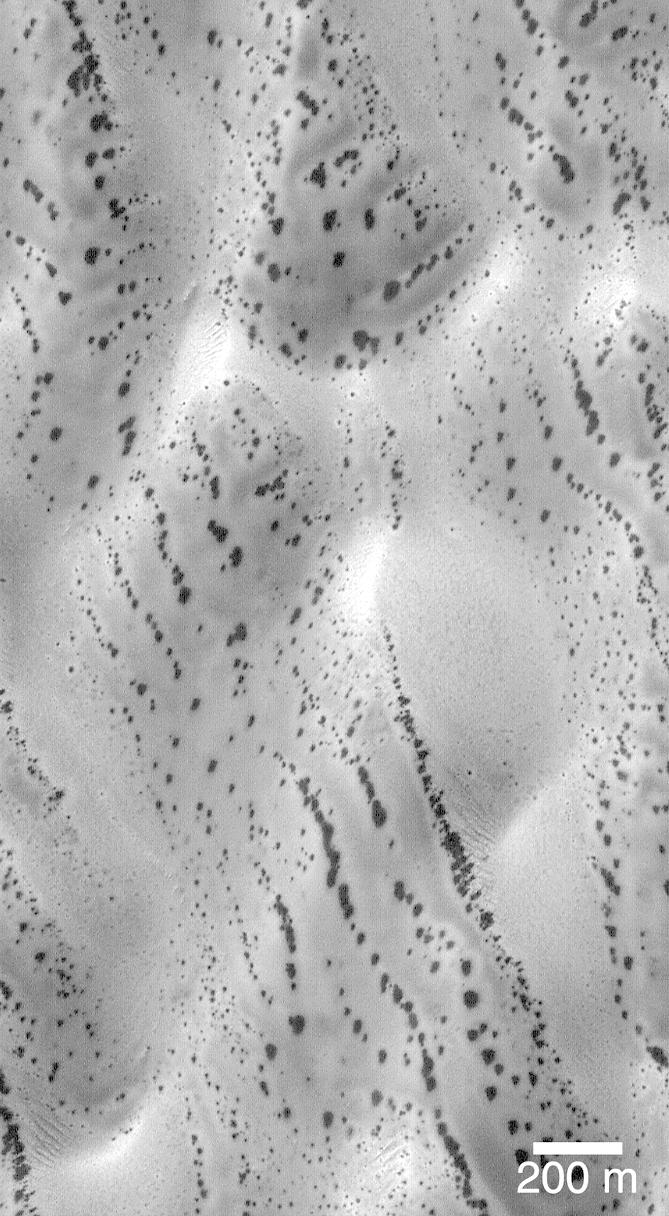
Defrosting Polar Dunes -- "The Snow Leopard"
The patterns created by dark spots on defrosting south polar dunes are often strange and beautiful. This picture, which the Mars Orbiter Camera team has dubbed, "the snow leopard," shows a dune field located at 61.5°S, 18.9°W, as it appeared on July 1, 1999. The spots are areas where dark sand has been exposed from beneath bright frost as the south polar winter cap begins to retreat. Many of the spots have a diffuse, bright ring around them this is thought to be fresh frost that was re-precipitated after being removed from the dark spot. The spots seen on defrosting polar dunes are a new phenomenon that was not observed by previous spacecraft missions to Mars. Thus, there is much about these features that remains unknown. For example, no one yet knows why the dunes become defrosted by forming small spots that grow and grow over time. No one knows for sure if the bright rings around the dark spots are actually composed of re-precipitated frost. And no one knows for sure why some dune show spots that appear to be "lined-up" (as they do in the picture shown here). This Mars Global Surveyor Mars Orbiter Camera image is illuminated from the upper left. North is toward the upper right. The scale bar indicates a distance of 200 meters (656 feet). http://photojournal.jpl.nasa.gov/catalog/PIA02301
Usage Rights
Most NASA images are in the public domain and free to use. Credit NASA as the source. Check NASA's media usage guidelines for details. Images featuring identifiable individuals may require additional permissions.
Keywords
Details
NASA ID
PIA02301
Date Created
May 16, 2000
Center
JPL
Media Type
image
Downloads
Download this image in multiple resolutions. All NASA media are free for public use.