NIMS: Hotspots on Io During G2
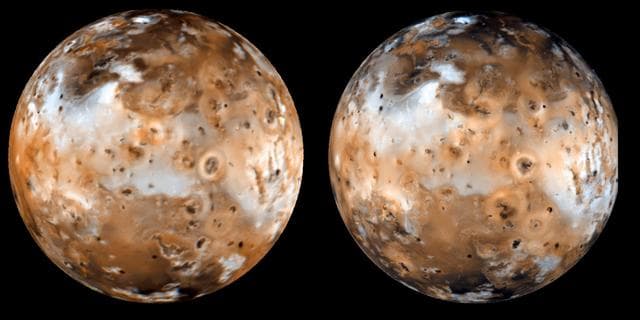
The Near Infrared Mapping Spectrometer (NIMS) on the Galileo spacecraft imaged Io at high spectral resolution at a range of 439,000 km (275,000 miles) during the G2 encounter on 7 September 1996. This image shows (on the right) Io as seen in the infrared by NIMS. The image on the left shows the same view from Voyager in 1979. This NIMS image can be compared to the NIMS images from the G1 orbit (June 1996) to monitor changes on Io. The NIMS image is at 4.9 microns, showing thermal emissions from the hotspots. The brightness of the pixels is a function of size and temperature. At least 10 hotspots have been identified and can be matched with surface features. An accurate determination of the position of the hotspot in the vicinity of Shamash Patera is pending. Hotspots are seen in the vicinity of Prometheus, Volund and Marduk, all sites of volcanic plume activity during the Galileo encounters, and also of active plumes in 1979. Temperatures and areas have been calculated for the hotspots shown. Temperatures range from 828 K (1031 F) to 210 K (- 81.4 F). The lowest temperature is significantly higher than the Io background (non-hotspot) surface temperature of about 100 K (-279 F). Hotspot areas range from 6.5 square km (2.5 sq miles) to 40,000 sq km (15,400 sq miles). The hottest hotspots have smallest areas, and the cooler hotspots have the largest areas. NIMS is continuing to observe Io to monitor volcanic activity throughout the Galileo mission. http://photojournal.jpl.nasa.gov/catalog/PIA00520
Usage Rights
Most NASA images are in the public domain and free to use. Credit NASA as the source. Check NASA's media usage guidelines for details. Images featuring identifiable individuals may require additional permissions.
Details
NASA ID
PIA00520
Date Created
March 26, 1998
Center
JPL
Media Type
image
Downloads
Download this image in multiple resolutions. All NASA media are free for public use.