Ridges on Europa
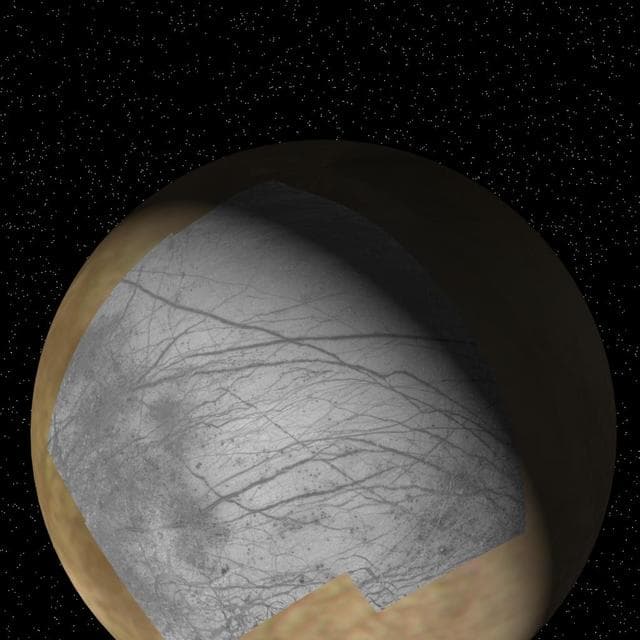
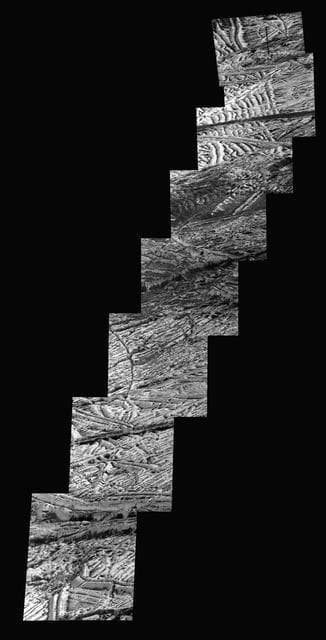
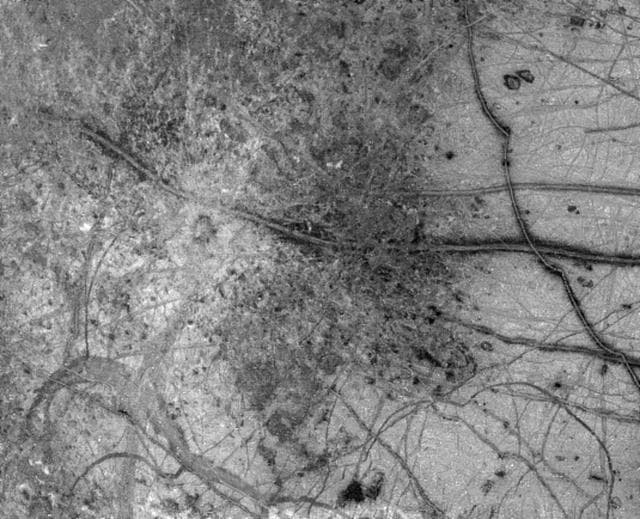
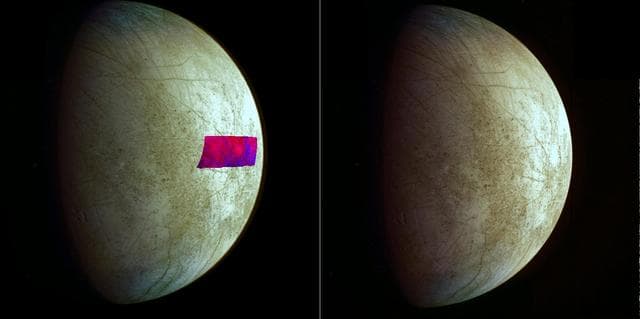
This view of Jupiter's moon Europa shows a portion of the surface that has been highly disrupted by fractures and ridges. This picture covers an area about 238 kilometers (150 miles) wide by 225 kilometers (140 miles), or about the distance between Los Angeles and San Diego. Symmetric ridges in the dark bands suggest that the surface crust was separated and filled with darker material, somewhat analogous to spreading centers in the ocean basins of Earth. Although some impact craters are visible, their general absence indicates a youthful surface. The youngest ridges, such as the two features that cross the center of the picture, have central fractures, aligned knobs, and irregular dark patches. These and other features could indicate cryovolcanism, or processes related to eruption of ice and gases. This picture, centered at 16 degrees south latitude, 196 degrees west longitude, was taken at a distance of 40,973 kilometers (25,290 mi) on November 6, 1996 by the Galileo spacecraft solid state imaging television camera onboard the Galileo spacecraft during its third orbit around Jupiter. http://photojournal.jpl.nasa.gov/catalog/PIA00518
Usage Rights
Most NASA images are in the public domain and free to use. Credit NASA as the source. Check NASA's media usage guidelines for details. Images featuring identifiable individuals may require additional permissions.
Details
NASA ID
PIA00518
Date Created
December 18, 1997
Center
JPL
Media Type
image
Downloads
Download this image in multiple resolutions. All NASA media are free for public use.