NASA’s Pegasus barge arrives at the Launch Complex 39 turn basin at the agency’s Kennedy Space Center in Florida carrying NASA’s Nancy Grace Roman Space Telescope on Sunday, June 21, 2026. Teams will offload and transport the observatory to the spaceport’s Payload Hazardous Servicing Facility where it will undergo processing ahead of launch, targeted no earlier than Sunday, Aug. 30, 2026. Named for NASA’s first chief astronomer and “mother of the Hubble Space Telescope,” Roman will offer a field of view over 100 times larger than Hubble’s to study up to a billion galaxies, directly image exoplanets and planet‑forming disks, and address fundamental questions about dark energy, exoplanets, and infrared astrophysics.
Most NASA images are in the public domain and free to use. Credit NASA as the source. Check NASA's media usage guidelines for details. Images featuring identifiable individuals may require additional permissions.
NASA ID
KSC-20260621-PH-AJN01_0311
Date Created
June 21, 2026
Center
KSC
Media Type
image
Photographer
NASA/Amber Jean Notvest
Location
Turn Basin, LC 39 Press Site
Download this image in multiple resolutions. All NASA media are free for public use.
Original
Full resolution
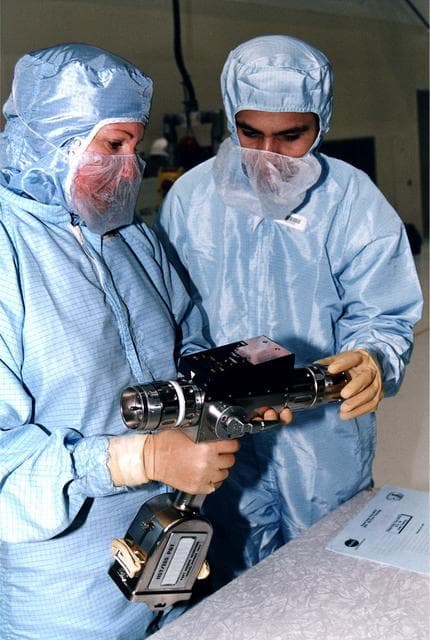
KENNEDY SPACE CENTER, FLA. - In KSC's Vertical Processing Facility, Louise Kleba of the Vehicle Integration Test Team (VITT) and engineer Devin Tailor of Goddard Space Flight Center examine the Pistol Grip Tool (PGT), which was designed for use by astronauts during spacewalks. The PGT is a self-contained, micro-processor controlled, battery-powered tool. It also can be used as a nonpowered ratchet wrench. The experiences of the astronauts on the first Hubble Space Telescope (HST) servicing mission led to recommendations for this smaller, more efficient tool for precision work during spacewalks. The PGT will be used on the second HST servicing mission, STS-82. Liftoff aboard Discovery is scheduled Feb. 11.
Jan 22, 1997
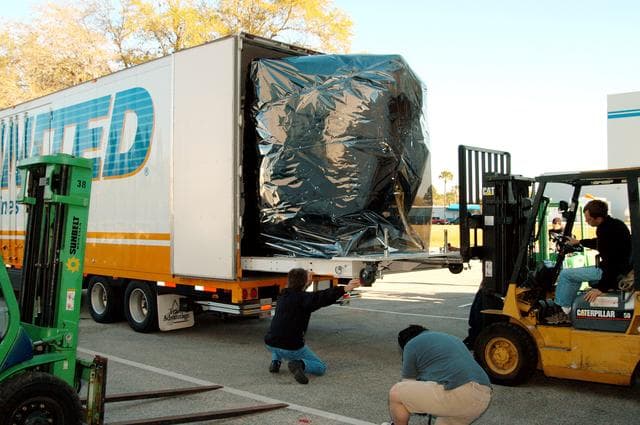
KENNEDY SPACE CENTER, FLA. - At the Astrotech Space Operations processing facilities near KSC, NASA’s MESSENGER spacecraft from NASA’s Goddard Space Flight Center in Greenbelt, Md., is offloaded. MESSENGER - short for MErcury Surface, Space ENvironment, GEochemistry and Ranging - will be taken into a high bay clean room and employees of the Johns Hopkins University Applied Physics Laboratory, builders of the spacecraft, will perform an initial state-of-health check. Then processing for launch can begin, including checkout of the power systems, communications systems and control systems. The thermal blankets will also be attached for flight. MESSENGER will be launched May 11 on a six-year mission aboard a Boeing Delta II rocket. Liftoff is targeted for 2:26 a.m. EDT on Tuesday, May 11.
Mar 10, 2004
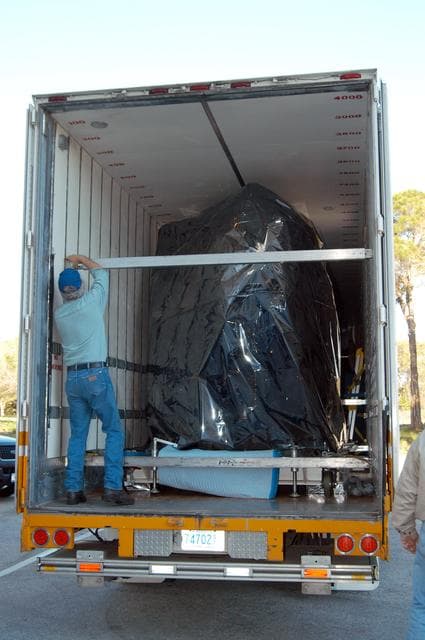
KENNEDY SPACE CENTER, FLA. - Doors are open on the air-conditioned transportation van that carried NASA’s MESSENGER spacecraft from NASA’s Goddard Space Flight Center in Greenbelt, Md., to the Astrotech Space Operations processing facilities near KSC. After offloading, MESSENGER - short for MErcury Surface, Space ENvironment, GEochemistry and Ranging - will be taken into a high bay clean room and employees of the Johns Hopkins University Applied Physics Laboratory, builders of the spacecraft, will perform an initial state-of-health check. Then processing for launch can begin, including checkout of the power systems, communications systems and control systems. The thermal blankets will also be attached for flight. MESSENGER will be launched May 11 on a six-year mission aboard a Boeing Delta II rocket. Liftoff is targeted for 2:26 a.m. EDT on Tuesday, May 11.
Mar 10, 2004
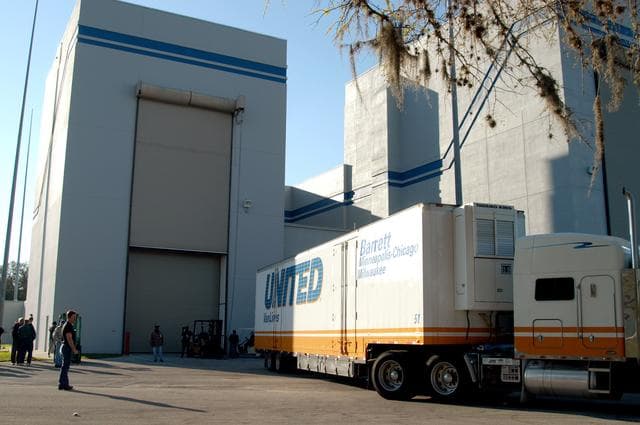
KENNEDY SPACE CENTER, FLA. - Shipped in an air-conditioned transportation van from NASA’s Goddard Space Flight Center in Greenbelt, Md., NASA’s MESSENGER spacecraft, the first Mercury orbiter, arrives at the Astrotech Space Operations processing facilities near KSC. MESSENGER - short for MErcury Surface, Space ENvironment, GEochemistry and Ranging - will be offloaded and taken into a high bay clean room. After the spacecraft is removed from its shipping container, employees of the Johns Hopkins University Applied Physics Laboratory, builders of the spacecraft, will perform an initial state-of-health check. Then processing for launch can begin, including checkout of the power systems, communications systems and control systems. The thermal blankets will also be attached for flight. MESSENGER will be launched May 11 on a six-year mission aboard a Boeing Delta II rocket. Liftoff is targeted for 2:26 a.m. EDT on Tuesday, May 11.
Mar 10, 2004