Jess Bunchek, an associate scientist at NASA’s Kennedy Space Center in Florida, harvests plant cultivars inside the Veggie growth chamber in the Space Station Processing Facility on Sept. 30, 2019, for a science verification test (SVT). This SVT will study the potential of three plants – amara mustard, ‘outredgeous’ red romaine lettuce and shungiku, an Asian green comparable to an edible chrysanthemum – to grow in space. All three lettuce plants were grown from seed film, making this the first SVT with this new plant growth material. Earlier this year, the amara mustard and shungiku plants were grown for the first time using seed bags – referred to as pillows – during the Sustained Veggie project, a study funded by the Human Research Program.
Most NASA images are in the public domain and free to use. Credit NASA as the source. Check NASA's media usage guidelines for details. Images featuring identifiable individuals may require additional permissions.
NASA ID
KSC-20190930-PH-CSH01_0053
Date Created
September 30, 2019
Center
KSC
Media Type
image
Photographer
NASA/Cory Huston
Location
SSPF
Download this image in multiple resolutions. All NASA media are free for public use.
Large
1920px
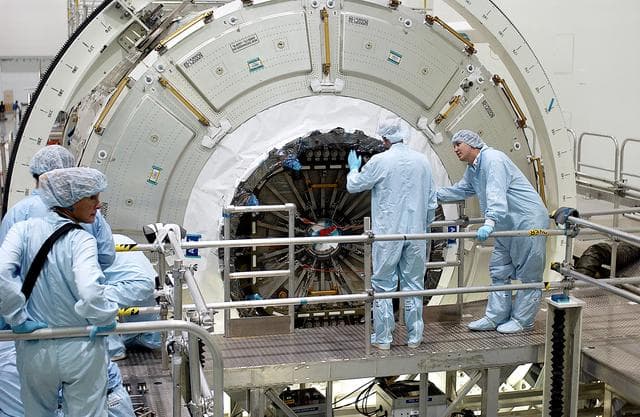
KENNEDY SPACE CENTER, FLA. - Workers in the Space Station Processing Facility attempt to open the hatch on the Italian-built Node 2, a future element of the International Space Station. Node 2 arrived at KSC June 1. The second of three Station connecting modules, the module attaches to the end of the U.S. Lab and provides attach locations for the Japanese laboratory, European laboratory, the Centrifuge Accommodation Module and, later, Multipurpose Logistics Modules. It will provide the primary docking location for the Shuttle when a pressurized mating adapter is attached to Node 2. Installation of the module will complete the U.S. Core of the ISS. Node 2 is the designated payload for mission STS-120. No orbiter or launch date has been determined yet.
Jun 6, 2003
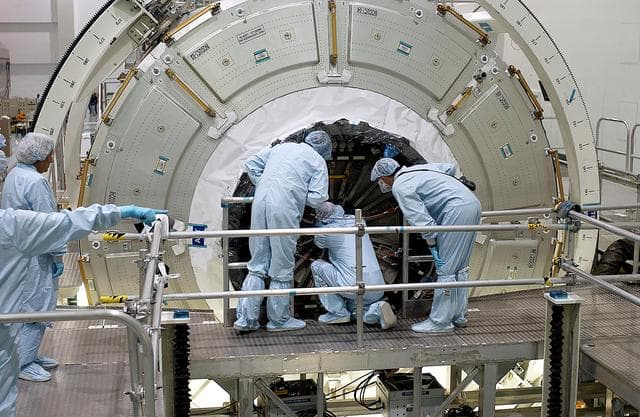
KENNEDY SPACE CENTER, FLA. - Workers in the Space Station Processing Facility look over the hatch on the Italian-built Node 2, a future element of the International Space Station. Node 2 arrived at KSC June 1. The second of three Station connecting modules, the module attaches to the end of the U.S. Lab and provides attach locations for the Japanese laboratory, European laboratory, the Centrifuge Accommodation Module and, later, Multipurpose Logistics Modules. It will provide the primary docking location for the Shuttle when a pressurized mating adapter is attached to Node 2. Installation of the module will complete the U.S. Core of the ISS. Node 2 is the designated payload for mission STS-120. No orbiter or launch date has been determined yet.
Jun 6, 2003
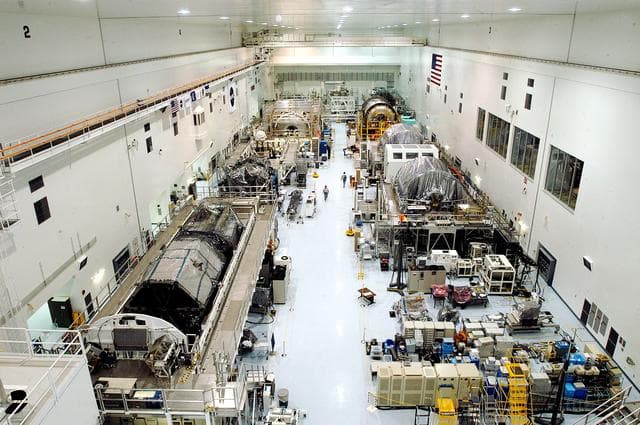
KENNEDY SPACE CENTER, FLA. - Various elements intended for the International Space Station are lined up in the Space Station Processing Facility. The newest to arrive at KSC are in the rear: at left, the U.S. Node 2, and next to it at right, the Japanese Experiment Module (JEM). The two elements are undergoing a Multi-Element Integrated Test (MEIT). Node 2 attaches to the end of the U.S. Lab on the ISS and provides attach locations for the Japanese laboratory, European laboratory, the Centrifuge Accommodation Module and, eventually, Multipurpose Logistics Modules. It will provide the primary docking location for the Shuttle when a pressurized mating adapter is attached to Node 2. Installation of the module will complete the U.S. Core of the ISS. Developed by the National Space Development Agency of Japan (NASDA), the JEM is Japan's primary contribution to the Station. It will enhance the unique research capabilities of the orbiting complex by providing an additional environment for astronauts to conduct science experiments.
Sep 3, 2003
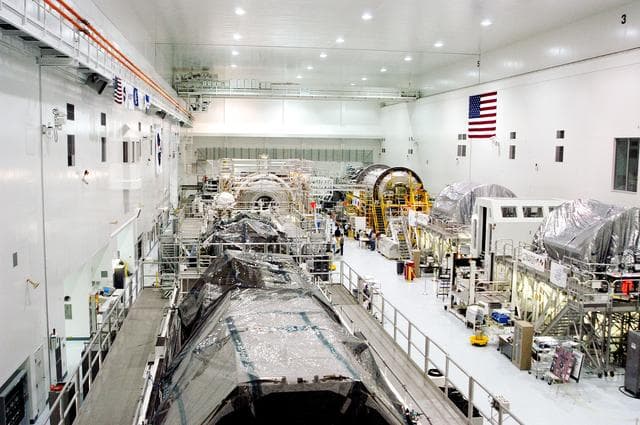
KENNEDY SPACE CENTER, FLA. - Various elements intended for the International Space Station are lined up in the Space Station Processing Facility. The newest to arrive at KSC are in the rear: at left, the U.S. Node 2, and at right, the Japanese Experiment Module (JEM). The two elements are undergoing a Multi-Element Integrated Test (MEIT). Node 2 attaches to the end of the U.S. Lab on the ISS and provides attach locations for the Japanese laboratory, European laboratory, the Centrifuge Accommodation Module and, eventually, Multipurpose Logistics Modules. It will provide the primary docking location for the Shuttle when a pressurized mating adapter is attached to Node 2. Installation of the module will complete the U.S. Core of the ISS. Developed by the National Space Development Agency of Japan (NASDA), the JEM is Japan's primary contribution to the Station. It will enhance the unique research capabilities of the orbiting complex by providing an additional environment for astronauts to conduct science experiments.
Aug 27, 2003