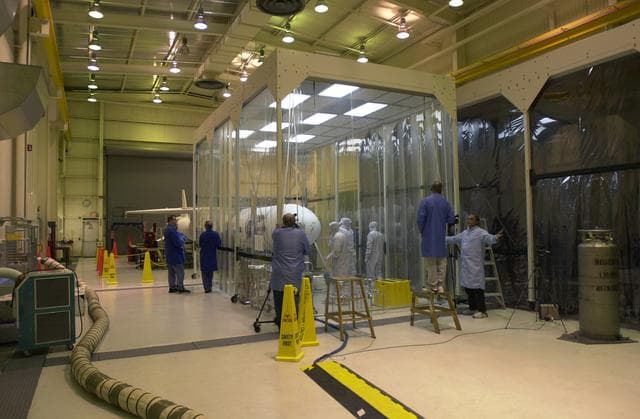
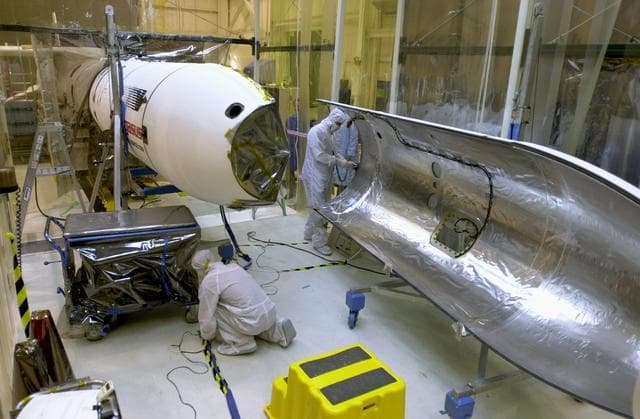
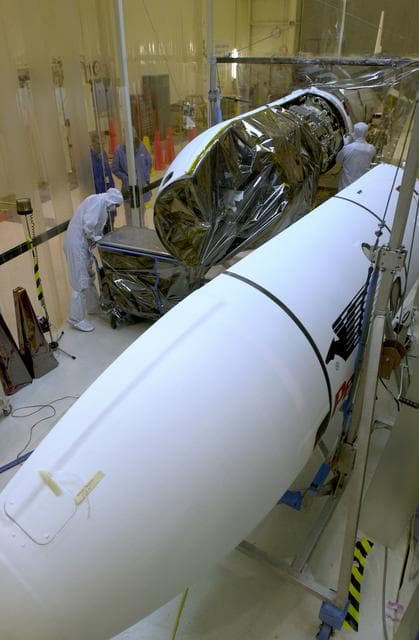
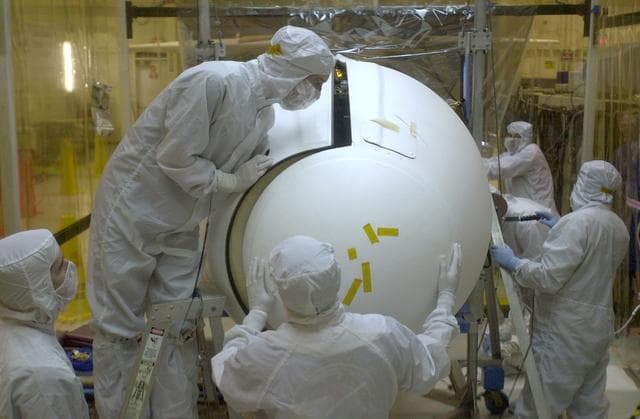
Technicians prepare the AIM spacecraft for fairing installation
At Vandenberg Air Force Base in California, under the protective clean tent, technicians move the second half of the fairing into place around the AIM spacecraft. The fairing is a molded structure that fits around the spacecraft and forms an aerodynamically smooth nose cone, protecting the spacecraft during launch. Launch will be from a Pegasus XL rocket, carried and released by Orbital Sciences L-1011 jet aircraft. AIM, which stands for Aeronomy of Ice in the Mesosphere, is being prepared for integrated testing and a flight simulation. The AIM spacecraft will fly three instruments designed to study polar mesospheric clouds located at the edge of space, 50 miles above the Earth's surface in the coldest part of the planet's atmosphere. The mission's primary goal is to explain why these clouds form and what has caused them to become brighter and more numerous and appear at lower latitudes in recent years. AIM's results will provide the basis for the study of long-term variability in the mesospheric climate and its relationship to global climate change. Launch is scheduled for April 25.
Usage Rights
Most NASA images are in the public domain and free to use. Credit NASA as the source. Check NASA's media usage guidelines for details. Images featuring identifiable individuals may require additional permissions.
Details
NASA ID
KSC-07PD-0970
Date Created
April 12, 2007
Center
KSC
Media Type
image
Photographer
NASA
Location
Vandenberg Air Force Base
Downloads
Download this image in multiple resolutions. All NASA media are free for public use.