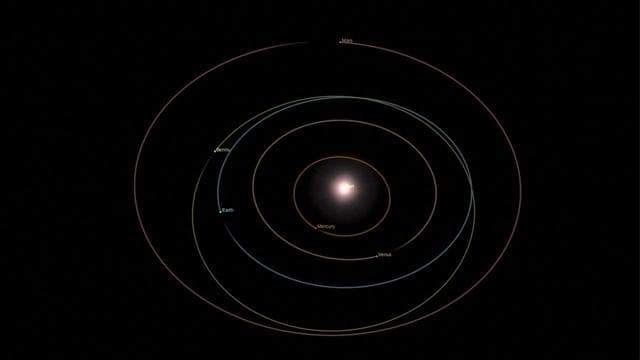
When NASA’s OSIRIS-REx spacecraft arrived at asteroid Bennu in December 2018, its close-up images confirmed what mission planners had predicted nearly two decades before: Bennu is made of loose material weakly clumped together by gravity, and shaped like a spinning top. This major validation, however, was accompanied by a major surprise. Scientists had expected Bennu’s surface to consist of fine-grained material like a sandy beach, but instead OSIRIS-REx was greeted by a rugged world littered with boulders – the size of cars, the size of houses, the size of football fields. The main science goal of OSIRIS-REx is to briefly touch down on Bennu and collect a sample for return to Earth, but the asteroid’s unexpected roughness could pose a hazard to the spacecraft. Areas for safely touching down are fewer and smaller than anticipated, and OSIRIS-REx will have to navigate to them with unprecedented accuracy. The 3D animations on this page were created using laser altimetry data and imagery of Bennu taken by OSIRIS-REx.
Most NASA images are in the public domain and free to use. Credit NASA as the source. Check NASA's media usage guidelines for details. Images featuring identifiable individuals may require additional permissions.
NASA ID
GSFC_20200226_M4795_BennuGlobal
Date Created
February 26, 2020
Center
GSFC
Media Type
video
Download this video in multiple resolutions. All NASA media are free for public use.
Captions
Subtitles