Magnetic Field Lines on the Sun
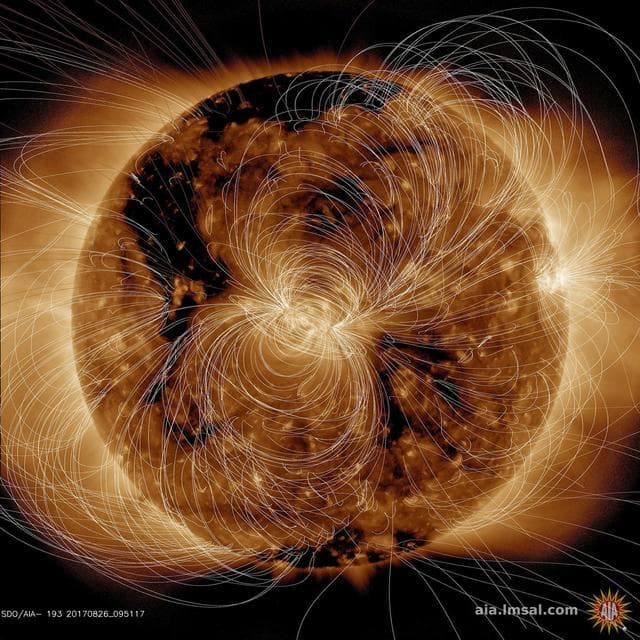
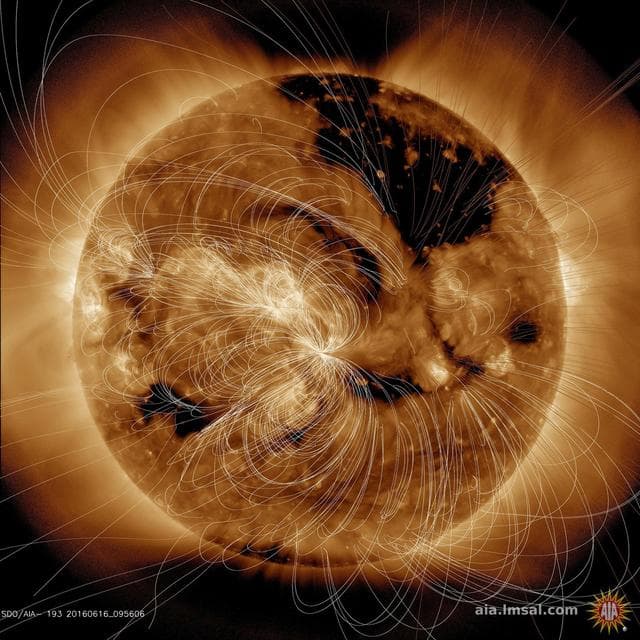
Scientists have developed a way to produce models of where the magnetic field lines are several times each day. Here we have created a time-lapse version of these models over four days (2-3 each day) to give you a peek at how these change over time. The spiraling arcs of magnetic field lines emerge from active regions and connect back to areas with the opposite polarity. The field lines are more concentrated where regions are more magnetically intense. And of course, they rotate with the rotation of the Sun. Credit: NASA/Solar Dynamics Observatory <b><a href="http://www.nasa.gov/audience/formedia/features/MP_Photo_Guidelines.html" rel="nofollow">NASA image use policy.</a></b> <b><a href="http://www.nasa.gov/centers/goddard/home/index.html" rel="nofollow">NASA Goddard Space Flight Center</a></b> enables NASA’s mission through four scientific endeavors: Earth Science, Heliophysics, Solar System Exploration, and Astrophysics. Goddard plays a leading role in NASA’s accomplishments by contributing compelling scientific knowledge to advance the Agency’s mission. <b>Follow us on <a href="http://twitter.com/NASAGoddardPix" rel="nofollow">Twitter</a></b> <b>Like us on <a href="http://www.facebook.com/pages/Greenbelt-MD/NASA-Goddard/395013845897?ref=tsd" rel="nofollow">Facebook</a></b> <b>Find us on <a href="http://instagram.com/nasagoddard?vm=grid" rel="nofollow">Instagram</a></b>
Usage Rights
Most NASA images are in the public domain and free to use. Credit NASA as the source. Check NASA's media usage guidelines for details. Images featuring identifiable individuals may require additional permissions.
Details
NASA ID
GSFC_20171208_Archive_e000808
Date Created
December 8, 2017
Center
GSFC
Media Type
image
Location
Greenbelt, MD
Downloads
Download this image in multiple resolutions. All NASA media are free for public use.