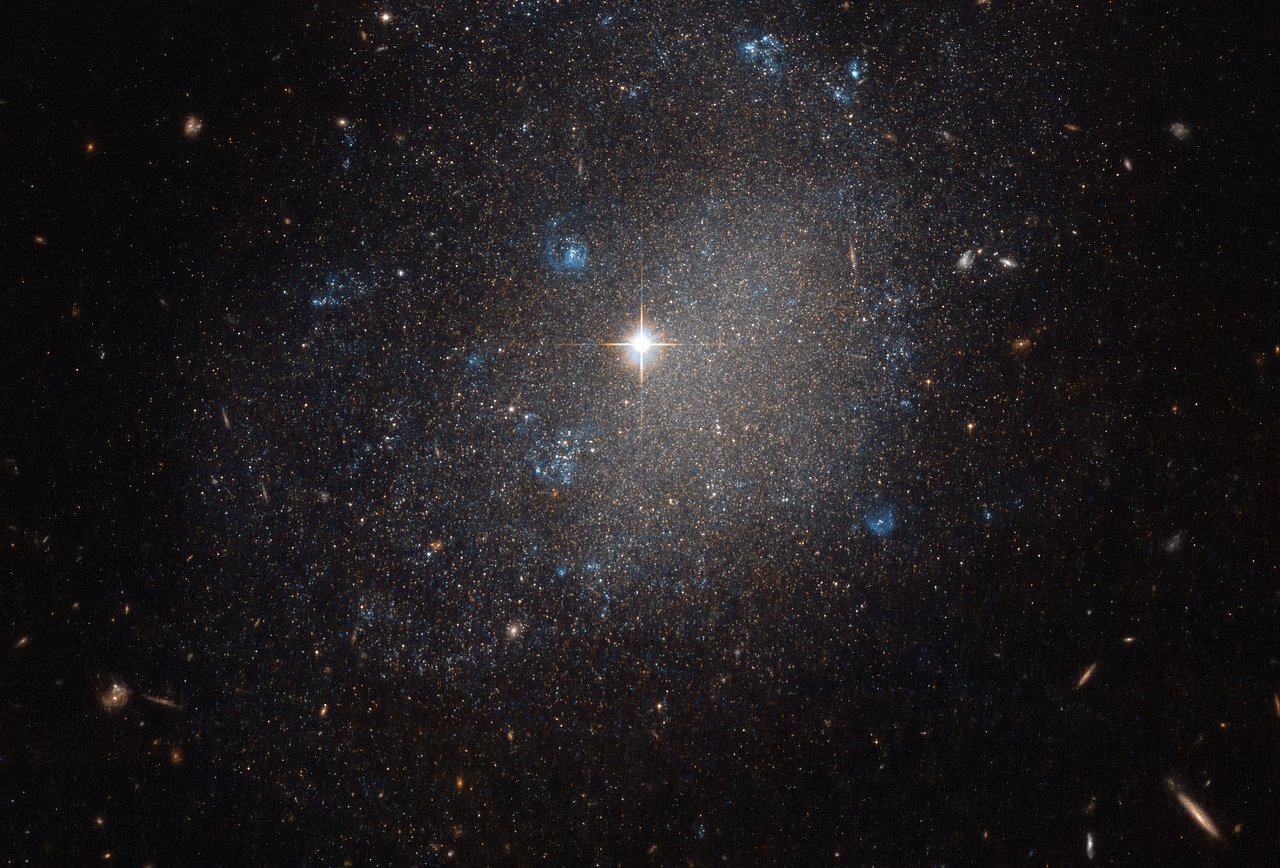
Hubble Chases a Small Stellar Galaxy in the Hunting Dog
On a clear evening in April of 1789, the renowned astronomer William Herschel continued his unrelenting survey of the night sky, hunting for new cosmic objects — and found cause to celebrate! He spotted this bright spiral galaxy, named NGC 4707, lurking in the constellation of Canes Venatici or The Hunting Dog. NGC 4707 lies roughly 22 million light-years from Earth. Over two centuries later, the NASA/ESA Hubble Space Telescope is able to "chase down" and view the same galaxy in far greater detail than Herschel could, allowing us to appreciate the intricacies and characteristics of NGC 4707 as never before. This striking image comprises observations from Hubble’s Advanced Camera for Surveys (ACS), one of a handful of high-resolution instruments currently aboard the space telescope. Herschel himself reportedly described NGC 4707 as a “small, stellar” galaxy; while it is classified as a spiral (type Sm), its overall shape, center, and spiral arms are very loose and undefined, and its central bulge is either very small or non-existent. It instead appears as a rough sprinkling of stars and bright flashes of blue on a dark canvas. The blue smudges seen across the frame highlight regions of recent or ongoing star formation, with newborn stars glowing in bright, intense shades of cyan and turquoise. Image credit: ESA/Hubble & NASA
Usage Rights
Most NASA images are in the public domain and free to use. Credit NASA as the source. Check NASA's media usage guidelines for details. Images featuring identifiable individuals may require additional permissions.
Details
NASA ID
GSFC_20171208_Archive_e000146
Date Created
December 8, 2017
Center
GSFC
Media Type
image
Location
Greenbelt, MD
Downloads
Download this image in multiple resolutions. All NASA media are free for public use.