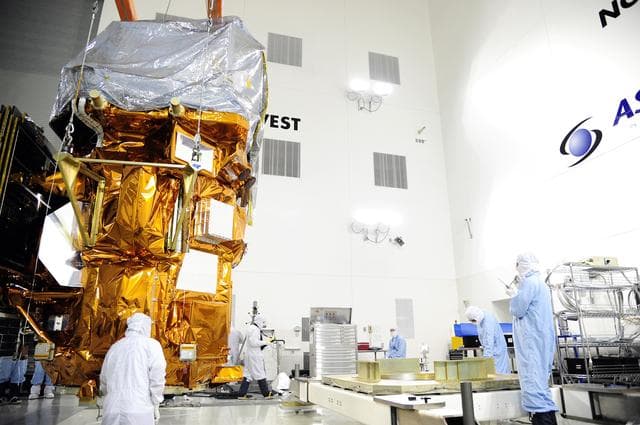
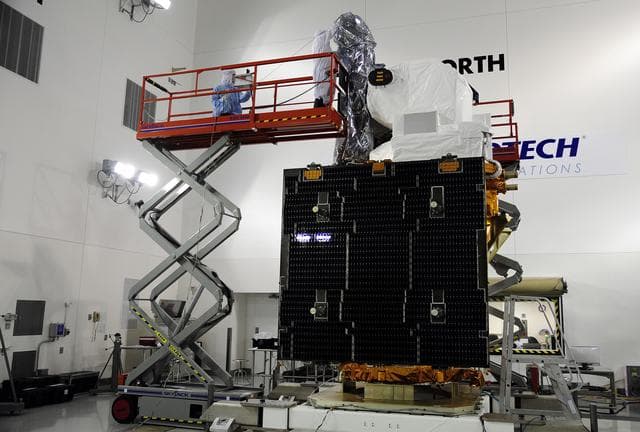
Landsat collects images in long narrow strips called “swaths.” Each swath is 185 kilometers (115 miles) wide and is 2,752 kilometers (1,710 miles) from the next adjacent swath taken that day. It takes 16 days for the swaths to overlap enough to image the whole Earth. Previous Landsat sensors swept back and forth across the swath like a whisk broom to collect data. The sensor looked at a calibration source at the end of every row, which means that measurements were consistent from orbit to orbit. But this sensor design requires fast-moving parts, which are more likely to break.—and which did on Landsat 7. In contrast, the instruments on Landsat 8 view across the entire swath at once, building strips of data like a pushbroom. This approach requires no moving parts and gives the sensor detectors greater dwell time. The pushbroom instrument is smaller and lighter than previous whisk broom instruments, but its calibration is much more complex given the large number of detectors. “It was a natural step to evolve to a pushbroom sensor. The technology was proven on other satellites, and we knew we could get better accuracy. The pushbroom has no moving parts. It is a newer and more reliable technology.” explains Terry Arvidson, senior project engineer. For more information on the future of Landsat instruments, read https://landsat.gsfc.nasa.gov/landsat-9/instruments/.
Most NASA images are in the public domain and free to use. Credit NASA as the source. Check NASA's media usage guidelines for details. Images featuring identifiable individuals may require additional permissions.
NASA ID
GSFC_20171031_Landsat_m12754_pushbroom
Date Created
October 31, 2017
Center
GSFC
Media Type
video
Location
Goddard Space Flight Center
Download this video in multiple resolutions. All NASA media are free for public use.
Captions
Subtitles