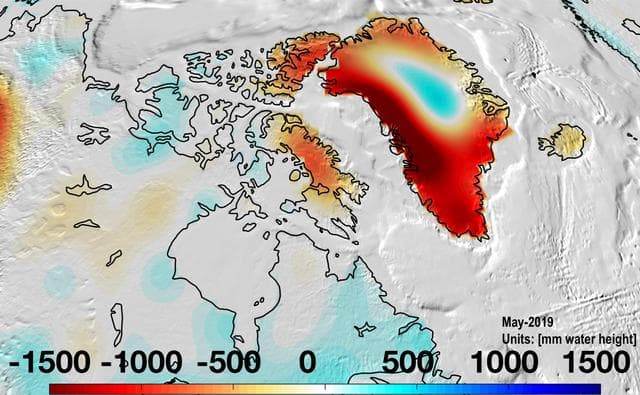
How can Greenland's ice sheets still be more than 10,000 feet thick, if carbon dioxide is warming the planet? This was the question posed to polar scientist Kelly Brunt as part of NASA's Ask A Climate Scientist series. According to Dr. Brunt, this is a great question because it addresses the concept of thickness, which is very important to polar scientists. It is easy to see that the ice sheets and sea ice are changing horizontally, covering less and less of the polar regions. But the ice is also thinning, getting smaller vertically. Dr. Brunt compares the situation to walking outside on a really cold day. When the air temperature is very cold, it will still take a while for her core body temperature to drop. Her skin may be chilly, but it will take time for that cold to work deep inside. Conversely, Greenland's ice is very thick and only the outer layer is experiencing the warming temperatures. But that layer is melting more often and a little bit of melting over such a large area produces a lot of extra water contributing to sea level rise.
Most NASA images are in the public domain and free to use. Credit NASA as the source. Check NASA's media usage guidelines for details. Images featuring identifiable individuals may require additional permissions.
NASA ID
GSFC_20150916_AACS_m11991_Thinning_Ice
Date Created
September 16, 2015
Center
GSFC
Media Type
video
Photographer
Robert Andreoli, John Caldwell
Location
Goddard Space Flight Center
Download this video in multiple resolutions. All NASA media are free for public use.
Captions
Subtitles