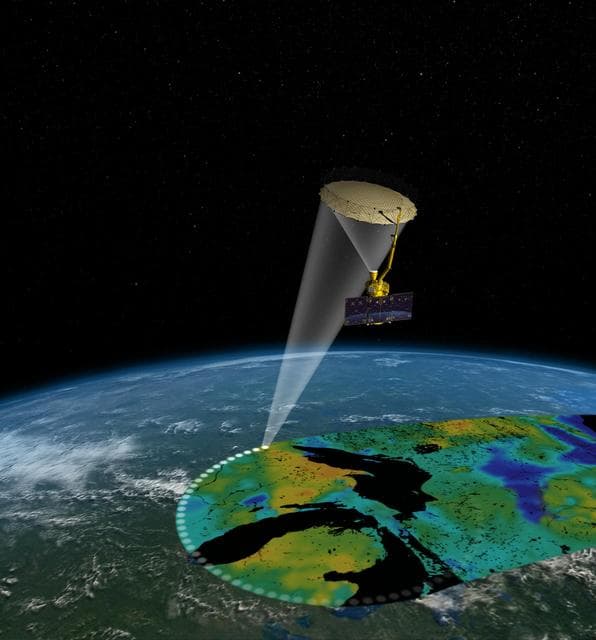
The microwave radiometer on NASA's Soil Moisture Active Passive (SMAP) satellite was designed and built at NASA's Goddard Space Flight Center. Along with the microwave radar, data from the radiometer will be used to calculate the water content of Earth's soil. All types of soil emit microwave radiation, but the amount of water changes how much of this energy is emitted. The drier the soil, the more microwave energy; the wetter the soil, the less energy. But radio frequency interference is a problem, even though the instrument is passively listening in a region of the microwave spectrum where transmission is prohibited. Some of the signals from the surrounding regions leak into the protected "listen-only" band. Goddard engineers developed new hardware and software to search for and cut out the erroneous measurements.
Most NASA images are in the public domain and free to use. Credit NASA as the source. Check NASA's media usage guidelines for details. Images featuring identifiable individuals may require additional permissions.
NASA ID
GSFC_20150127_SMAP_m11743_Radiometer
Date Created
January 27, 2015
Center
GSFC
Media Type
video
Photographer
Robert Andreoli, John Caldwell
Location
Goddard Space Flight Center
Download this video in multiple resolutions. All NASA media are free for public use.
Captions
Subtitles