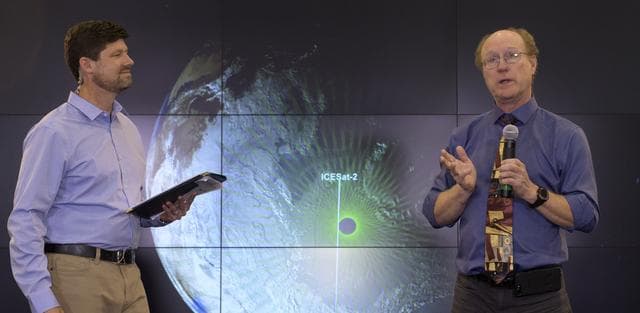
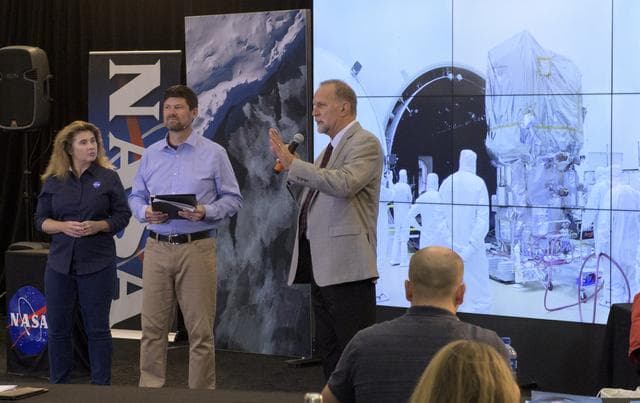
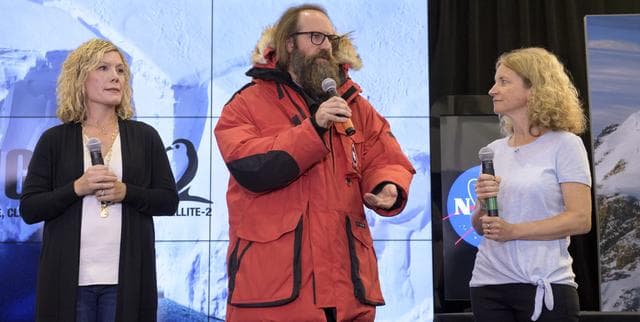
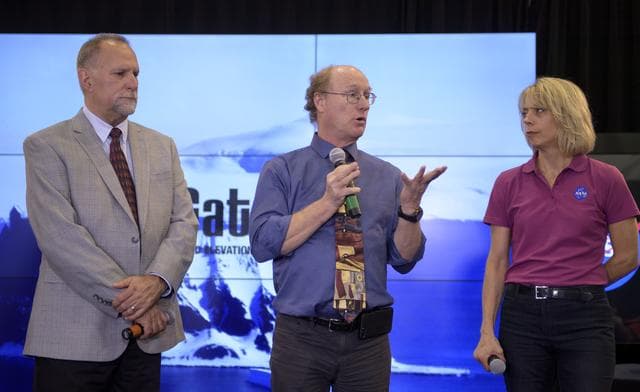
The Ice, Cloud and land Elevation Satellite-2, or ICESat-2, is a laser altimeter that will measure the heights of Earth’s surfaces. With ICESat-2’s high-resolution data, scientists will track changes to Earth’s ice-covered poles, which is witnessing dramatic temperature increases. The mission will also take stock of forests, map ocean surfaces, characterize clouds and more. ICESat-2 carries a single instrument called the Advanced Topographic Laser Altimeter System (ATLAS), equipped with a multiple-beam laser, which sends 10,000 pulses of light to the ground each second. A small fraction of the light photons bounce off Earth’s surface and return to the instrument, where a photon-counting detector times their flight. Knowing this time, and the satellite’s position and orientation in space, scientists can calculate Earth’s elevation below. ICESat-2 continues key elevation observations begun by the original ICESat satellite (2003 to 2009) and Operation IceBridge (2009 through present), to provide a portrait of change in the beginning of the 21st century.
Most NASA images are in the public domain and free to use. Credit NASA as the source. Check NASA's media usage guidelines for details. Images featuring identifiable individuals may require additional permissions.
NASA ID
GSFC_20141015_ICESat2_m11712_Deploy_Beauty
Date Created
October 15, 2014
Center
GSFC
Media Type
video
Location
Goddard Space Flight Center
Download this video in multiple resolutions. All NASA media are free for public use.
Captions
Subtitles