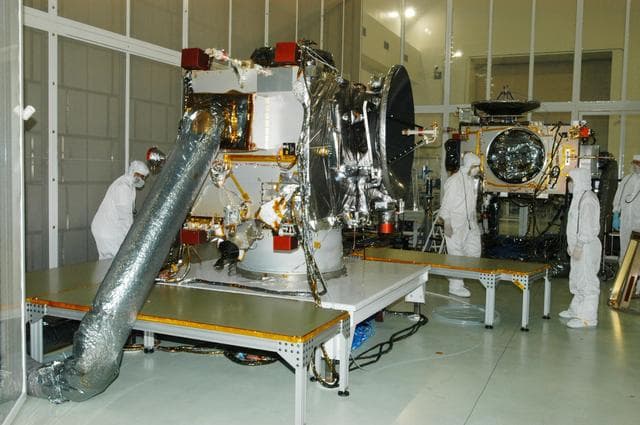
On Jan. 28, 2014, NASA's Interface Region Imaging Spectrograph, or IRIS, witnessed its strongest solar flare since it launched in the summer of 2013. Solar flares are bursts of x-rays and light that stream out into space, but scientists don't yet know the fine details of what sets them off. IRIS peers into a layer of the sun's lower atmosphere just above the surface, called the chromosphere, with unprecedented resolution. However, IRIS can't look at the entire sun at the same time, so the team must always make decisions about what region might provide useful observations. On Jan. 28, scientists spotted a magnetically active region on the sun and focused IRIS on it to see how the solar material behaved under intense magnetic forces. At 2:40 p.m. EST, a moderate flare, labeled an M-class flare — which is the second strongest class flare after X-class – erupted from the area, sending light and x-rays into space. IRIS studies the layer of the sun’s atmosphere called the chromosphere that is key to regulating the flow of energy and material as they travel from the sun's surface out into space. Along the way, the energy heats up the upper atmosphere, the corona, and sometimes powers solar events such as this flare. IRIS is equipped with an instrument called a spectrograph that can separate out the light it sees into its individual wavelengths, which in turn correlates to material at different temperatures, velocities and densities. The spectrograph on IRIS was pointed right into the heart of this flare when it reached its peak, and so the data obtained can help determine how different temperatures of plasma flow where, giving scientists more insight into how flares work.
Most NASA images are in the public domain and free to use. Credit NASA as the source. Check NASA's media usage guidelines for details. Images featuring identifiable individuals may require additional permissions.
NASA ID
GSFC_20140221_IRIS_m11483_Flare
Date Created
February 21, 2014
Center
GSFC
Media Type
video
Location
Goddard Space Flight Center
Download this video in multiple resolutions. All NASA media are free for public use.
Captions
Subtitles