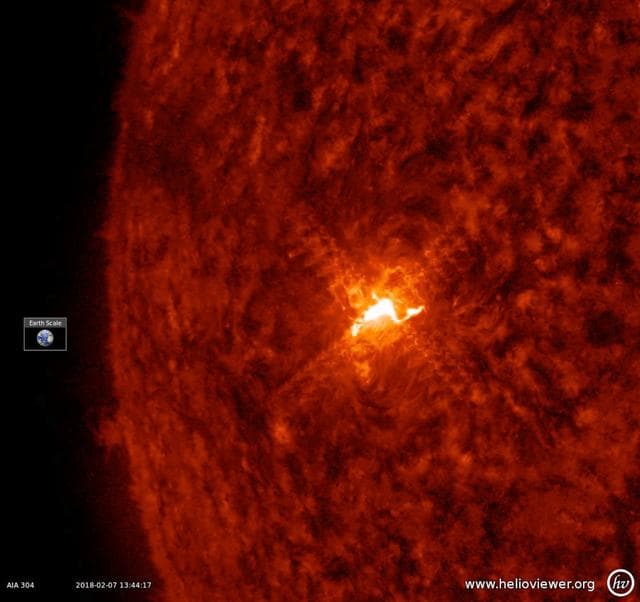
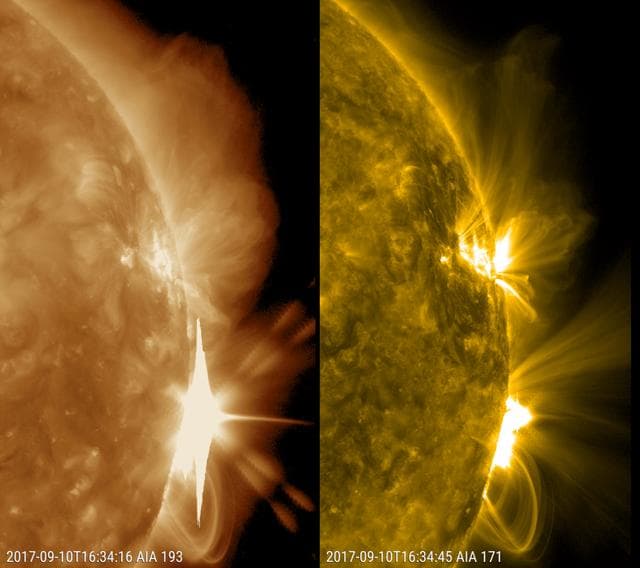
On Jan 30, 2014, beginning at 8:31 a.m EST, the moon moved between NASA’s Solar Dynamics Observatory, or SDO, and the sun, giving the observatory a view of a partial solar eclipse from space. Such a lunar transit happens two to three times each year. This one lasted two and one half hours, which is the longest ever recorded. When the next one will occur is as of yet unknown due to planned adjustments in SDO's orbit. Note in the pictures how crisp the horizon is on the moon, a reflection of the fact that the moon has no atmosphere around it to distort the light from the sun. The sun emitted a mid-level solar flare, peaking at 11:11 a.m. EST on Jan. 30, 2014. Images of the flare were captured by NASA's Solar Dynamics Observatory, or SDO, shortly after the observatory witnessed a lunar transit. The black disk of the moon can be seen in the lower right of the images.
Most NASA images are in the public domain and free to use. Credit NASA as the source. Check NASA's media usage guidelines for details. Images featuring identifiable individuals may require additional permissions.
NASA ID
GSFC_20140130_SDO_m11463_Eclipse-Flare
Date Created
January 30, 2014
Center
GSFC
Media Type
video
Location
Goddard Space Flight Center
Download this video in multiple resolutions. All NASA media are free for public use.
Captions
Subtitles

![SKYLAB (SL)-3 - EXPERIMENTS (APOLLO TELESCOPE MOUNT [ATM])](/_next/image?url=https%3A%2F%2Fimages-assets.nasa.gov%2Fimage%2FS74-23458%2FS74-23458~thumb.jpg&w=1920&q=75)