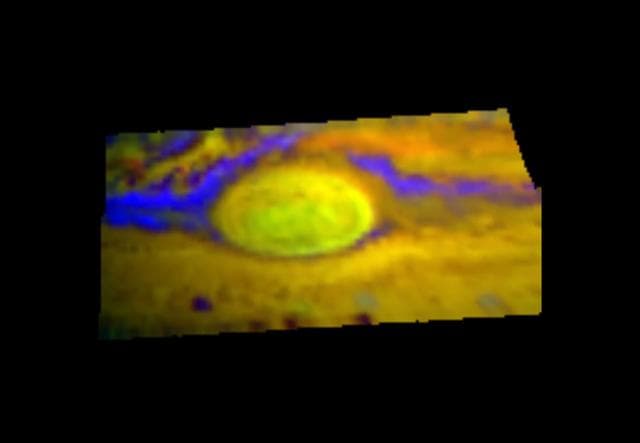
Jupiter's bright Equatorial Zone swirls with dark patches, dubbed "hot spots" for their infrared glow. These holes in the ammonia clouds at the top of the atmosphere allow a glimpse into Jupiter's darker, hotter layers below. In 1995 NASA's Galileo spacecraft dropped a probe directly into a hot spot, taking the first and only in situ measurements of Jupiter's atmosphere. Now, movies recorded by NASA's Cassini spacecraft reveal that hot spots are not just local weather phenomena, but are in fact linked to much larger-scale atmospheric structures called Rossby waves.
Most NASA images are in the public domain and free to use. Credit NASA as the source. Check NASA's media usage guidelines for details. Images featuring identifiable individuals may require additional permissions.
NASA ID
GSFC_20130314_Jupiter_m11204_HotSpots
Date Created
March 14, 2013
Center
GSFC
Media Type
video
Photographer
Robert Andreoli, Greg Shirah, Ernie Wright, Trent Schindler, Lori Perkins
Location
Goddard Space Flight Center
Download this video in multiple resolutions. All NASA media are free for public use.
Captions
Subtitles