ARC-1981-A86-7007
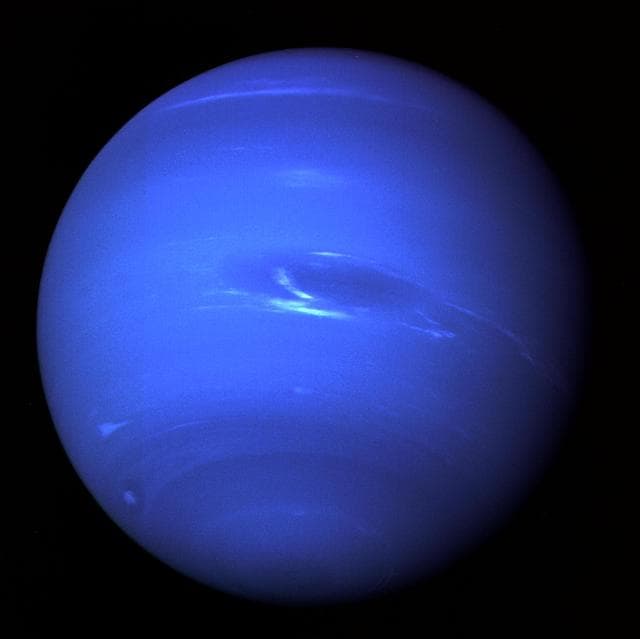
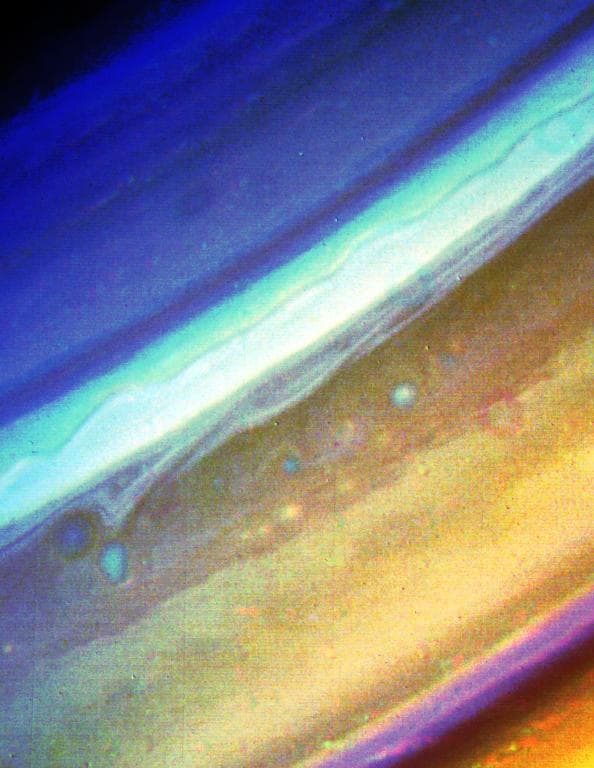
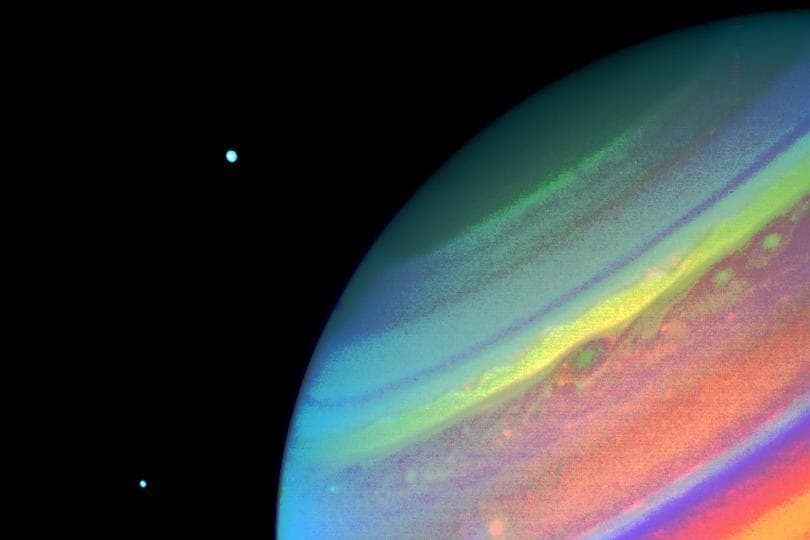
Range : 12.9 million km. ( 8.0 million miles ) P-29467B/W Time lapse Voyager 2 images of Uranus show the movement of two small, bright, streaky clouds, the first such features ever seen on the planet. The clouds were detected in this series of orange filtered images, over a 4.6 hour interval ( from top to bottom ). Uranus, which is tipped on its side with respect to the other planets, is rotating in a counter-clockwise direction, with its pole of rotation near the center of the disk, as are the two clouds seen here as bright streaks. The larger of the two clouds is ata lattitude of 33 degrees. The smaller cloud, seen faintly in the three lower images, lies at 26 degrees ( a lower alttitude and hence closer to the limb). Their counterclockwise periods of rotation are 16.2 and 16.9 hours, respectively. This difference implies that the lower lattitude feature is lagging behind the higher latitude feture at a speed of almost 100 meters pers second (220 mph). Latitudinal bands are also visible in these images, the faint bands, more numerous now then in previous Voyager images from longer range, are concentric with the pole rotation. thatis, they circle the planet in lines of contant latitude.
Usage Rights
Most NASA images are in the public domain and free to use. Credit NASA as the source. Check NASA's media usage guidelines for details. Images featuring identifiable individuals may require additional permissions.
Keywords
Details
NASA ID
ARC-1981-A86-7007
Date Created
January 14, 1981
Center
ARC
Media Type
image
Photographer
JPL
Downloads
Download this image in multiple resolutions. All NASA media are free for public use.