Research Technology
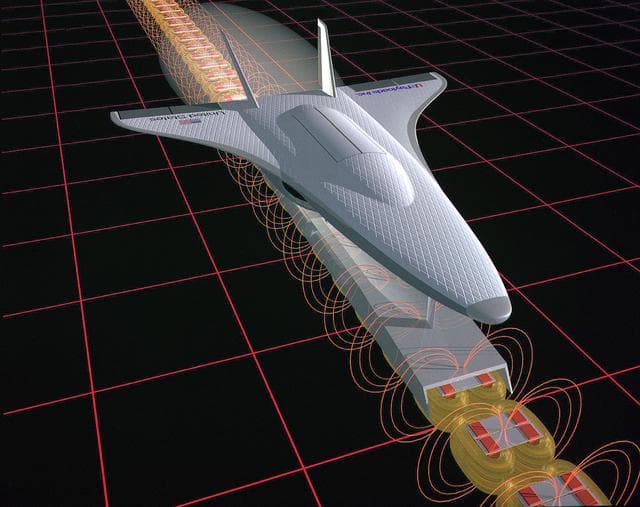
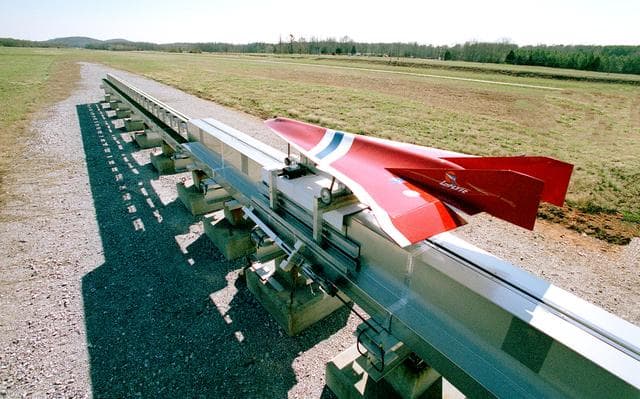
In this photograph, a futuristic spacecraft model sits atop a carrier on the Magnetic Launch Assist System, formerly known as the Magnetic Levitation (MagLev) System, experimental track at the Marshall Space Flight Center (MSFC). Engineers at MSFC have developed and tested Magnetic Launch Assist technologies that would use magnetic fields to levitate and accelerate a vehicle along a track at very high speeds. Similar to high-speed trains and roller coasters that use high-strength magnets to lift and propel a vehicle a couple of inches above a guideway, a Magnetic Launch Assist system would electromagnetically drive a space vehicle along the track. A full-scale, operational track would be about 1.5-miles long and capable of accelerating a vehicle to 600 mph in 9.5 seconds. This track is an advanced linear induction motor. Induction motors are common in fans, power drills, and sewing machines. Instead of spinning in a circular motion to turn a shaft or gears, a linear induction motor produces thrust in a straight line. Mounted on concrete pedestals, the track is 100-feet long, about 2-feet wide, and about 1.5-feet high. The major advantages of launch assist for NASA launch vehicles is that it reduces the weight of the take-off, the landing gear, the wing size, and less propellant resulting in significant cost savings. The US Navy and the British MOD (Ministry of Defense) are planning to use magnetic launch assist for their next generation aircraft carriers as the aircraft launch system. The US Army is considering using this technology for launching target drones for anti-aircraft training.
Usage Rights
Most NASA images are in the public domain and free to use. Credit NASA as the source. Check NASA's media usage guidelines for details. Images featuring identifiable individuals may require additional permissions.
Details
NASA ID
9906088
Date Created
October 1, 1999
Center
MSFC
Media Type
image
Downloads
Download this image in multiple resolutions. All NASA media are free for public use.