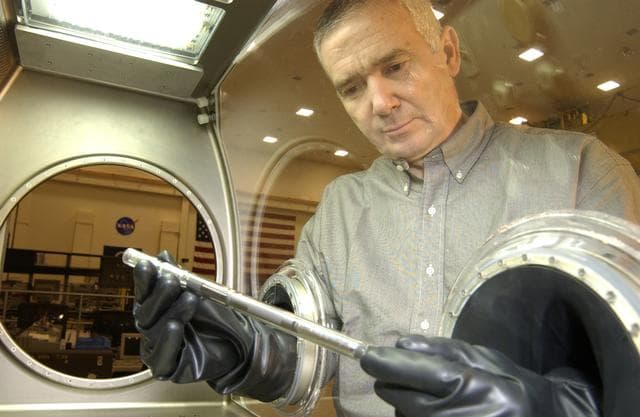
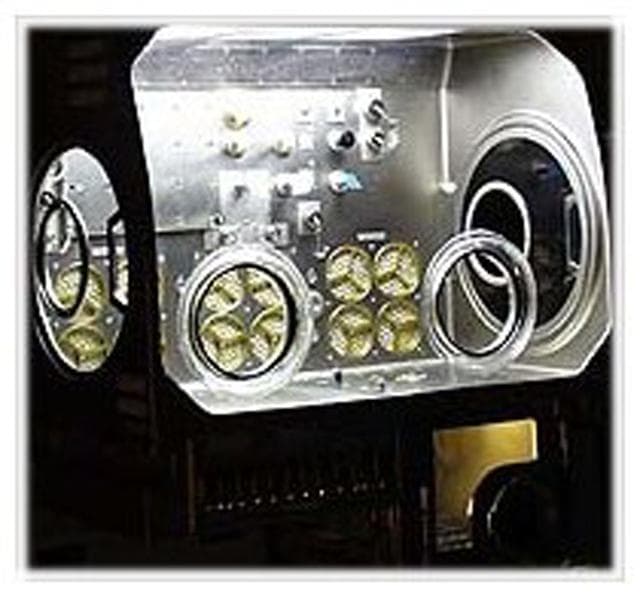
The objective of this facility is to investigate the potential of space grown semiconductor materials by the vapor transport technique and develop powdered metal and ceramic sintering techniques in microgravity. The materials processed or developed in the SEF have potential application for improving infrared detectors, nuclear particle detectors, photovoltaic cells, bearing cutting tools, electrical brushes and catalysts for chemical production. Flown on STS-60 Commercial Center: Consortium for Materials Development in Space - University of Alabama Huntsville (UAH)
Most NASA images are in the public domain and free to use. Credit NASA as the source. Check NASA's media usage guidelines for details. Images featuring identifiable individuals may require additional permissions.
NASA ID
9804667
Date Created
February 3, 1994
Center
MSFC
Media Type
image
Download this image in multiple resolutions. All NASA media are free for public use.
480px
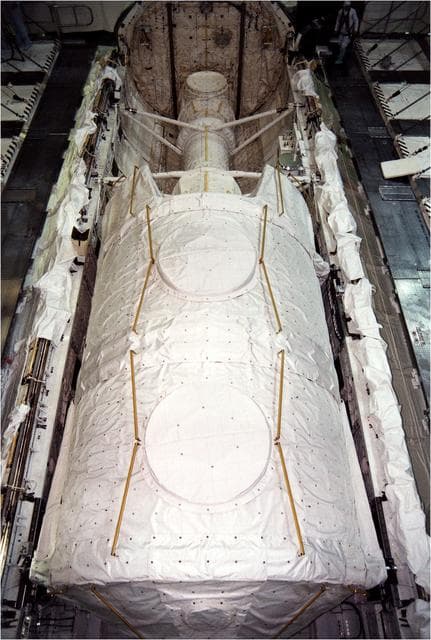
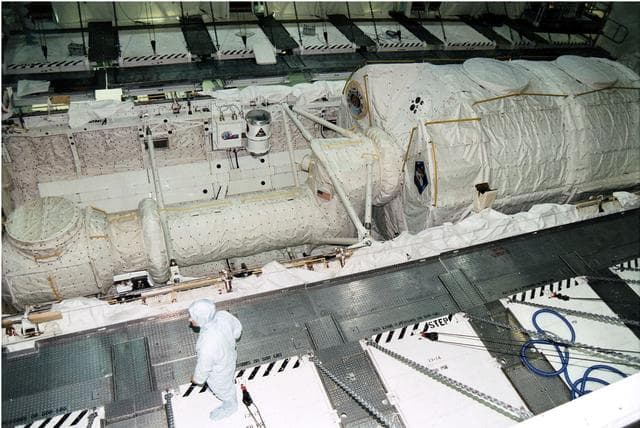
KENNEDY SPACE CENTER, FLA. - The Microgravity Science Laboratory-1 (MSL-1) Spacelab module is installed into the payload bay of the Space Shuttle Orbiter Columbia in Orbiter Processing Facility 1. The Spacelab long crew transfer tunnel that leads from the orbiter's crew airlock to the module is also aboard, as well as the Hitchhiker Cryogenic Flexible Diode (CRYOFD) experiment payload, which is attached to the right side of Columbia's payload bay. During the scheduled 16-day STS-83 mission, the MSL-1 will be used to test some of the hardware, facilities and procedures that are planned for use on the International Space Station while the flight crew conducts combustion, protein crystal growth and materials processing experiments.
Feb 13, 1997
KENNEDY SPACE CENTER, FLA. - The Microgravity Science Laboratory-1 (MSL-1) Spacelab module is installed into the payload bay of the Space Shuttle Orbiter Columbia in Orbiter Processing Facility 1. The Spacelab long crew transfer tunnel that leads from the orbiter's crew airlock to the module is also aboard, as well as the Hitchhiker Cryogenic Flexible Diode (CRYOFD) experiment payload, which is attached to the right side of Columbia's payload bay. During the scheduled 16-day STS-83 mission, the MSL-1 will be used to test some of the hardware, facilities and procedures that are planned for use on the International Space Station while the flight crew conducts combustion, protein crystal growth and materials processing experiments.
Feb 13, 1997
Material Science
Jan 22, 2003
Microgravity
Sep 15, 1999