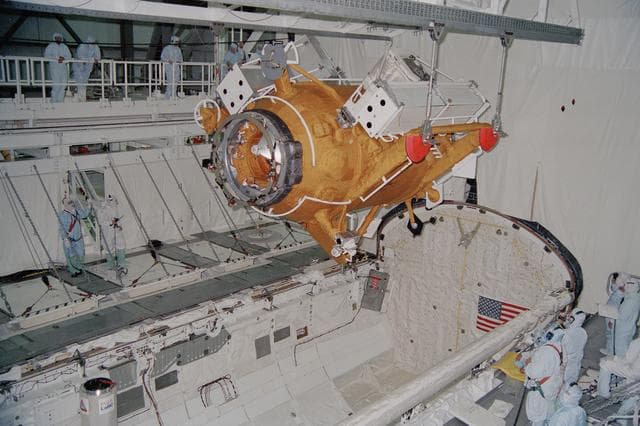
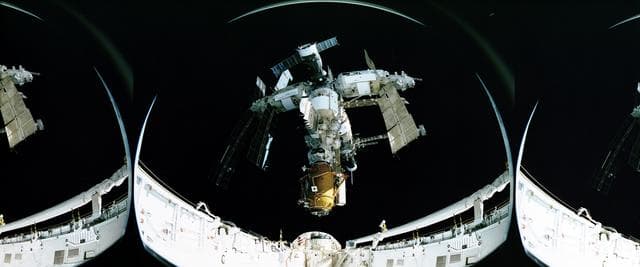
This image of the Russian Mir Space Station was photographed by a crewmember of the STS-74 mission when the Orbiter Atlantis was approaching the Mir Space Station. STS-74 was the second Space Shuttle/Mir docking mission. The Docking Module was delivered and installed, making it possible for the Space Shuttle to dock easily with Mir. The Orbiter Atlantis delivered water, supplies, and equipment, including two new solar arrays to upgrade the Mir, and returned to Earth with experiment samples, equipment for repair and analysis, and products manufactured on the Station. Mir was constructed in orbit by cornecting different modules, seperately launched from 1986 to 1996, providing a large and livable scientific laboratory in space. The 100-ton Mir was as big as six school buses and commonly housed three crewmembers. Mir was continuously occupied, except for two short periods, and hosted international scientists and American astronauts until August 1999. The journey of the 15-year-old Russian Mir Space Station ended March 23, 2001, as Mir re-entered the Earth's atmosphere and fell into the south Pacific ocean . STS-74 was launched on November 12, 1995, and landed at the Kennedy Space Center on November 20, 1995.
Most NASA images are in the public domain and free to use. Credit NASA as the source. Check NASA's media usage guidelines for details. Images featuring identifiable individuals may require additional permissions.
NASA ID
9613543
Date Created
November 1, 1995
Center
MSFC
Media Type
image
Download this image in multiple resolutions. All NASA media are free for public use.
1920px
Space Shuttle Projects
Nov 1, 1995
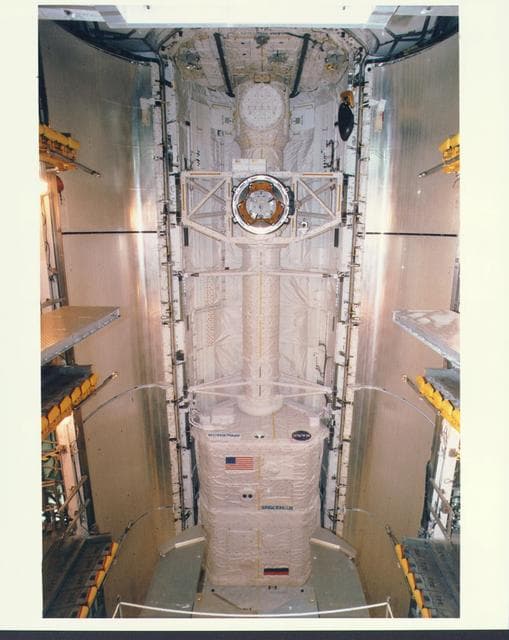
KENNEDY SPACE CENTER, FLA. - Workers in the Payload Changeout Room (PCR) at Launch Pad 39A are preparing to close the payload doors for flight on the Space Shuttle Atlantis, targeted for liftoff on Mission STS-79 around Sept. 12. The payloads in Atlantis' cargo bay will play key roles during the upcoming spaceflight, which will be highlighted by the fourth docking between the U.S. Shuttle and Russian Space Station Mir. Located in the aft (lowermost) area of the payload bay is the SPACEHAB Double Module, filled with supplies and other items slated for transfer to the Russian Space Station Mir as well as research equipment. The SPACEHAB is connected by tunnel to the Orbiter Docking System (ODS). This view looks directly at the top of the ODS and shows clearly the Androgynous Peripheral Docking System (APDS) that interfaces with the Docking Module on Mir to achieve a linkup.
Aug 22, 1996
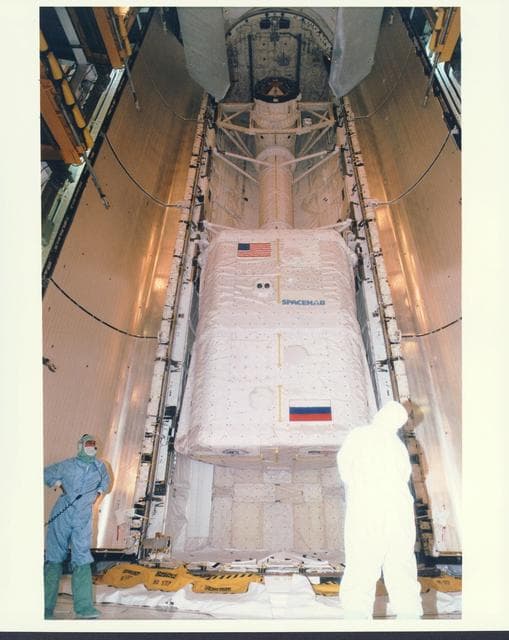
KENNEDY SPACE CENTER, FLA. - Workers in the Payload Changeout Room (PCR) at Launch Pad 39A are preparing to close the payload doors for flight on the Space Shuttle Atlantis, targeted for liftoff on Mission STS-79 around Sept. 12. The SPACEHAB Double Module located in the aft area of the payload bay is filled with supplies and other items slated for transfer to the Russian Space Station Mir. STS-79 marks the second flight of a SPACEHAB in support of the Shuttle-Mir dockings, and the first flight of the double-module configuration. The SPACEHAB is connected by tunnel to the Orbiter Docking System (ODS), with the Androgynous Peripheral Docking System (APDS) clearly visible on top of the ODS. The APDS provides the docking interface for the linkup with Mir, while the ODS provides a passageway from the orbiter to the Russian space station and the SPACEHAB.
Aug 22, 1996
KSC-95PC-1324
Sep 11, 1995