Spacelab
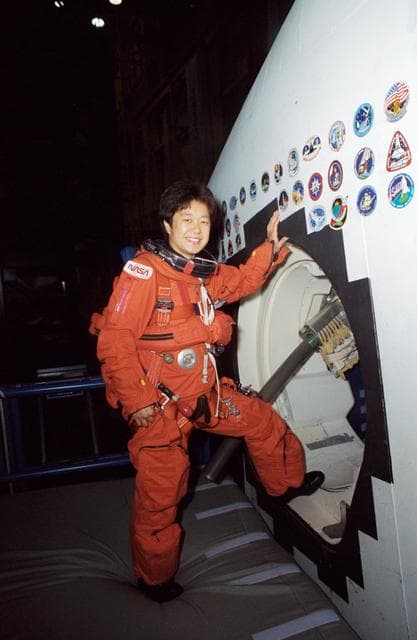
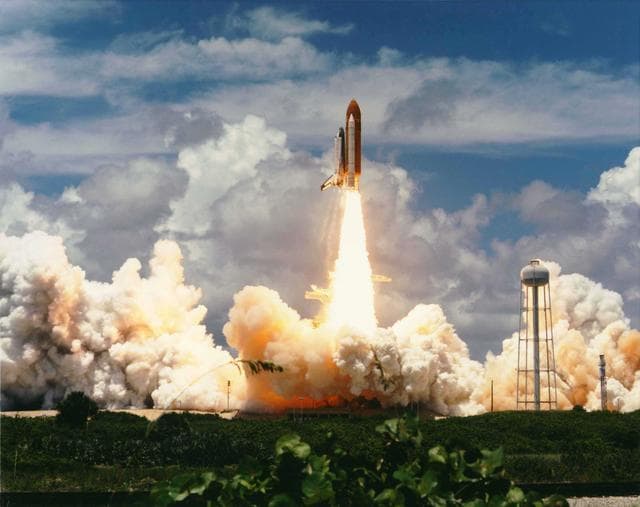
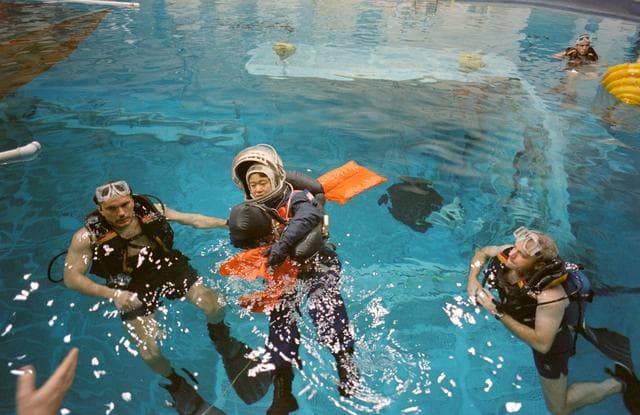
Astronaut Chiaki Mukai conducts the Lower Body Negative Pressure (LBNP) experiment inside the International Microgravity Laboratory-2 (IML-2) mission science module. Dr. Chiaki Mukai is one of the National Space Development Agency of Japan (NASDA) astronauts chosen by NASA as a payload specialist (PS). She was the second NASDA PS who flew aboard the Space Shuttle, and was the first female astronaut in Asia. When humans go into space, the lack of gravity causes many changes in the body. One change is that fluids normally kept in the lower body by gravity shift upward to the head and chest. This is why astronauts' faces appear chubby or puffy. The change in fluid volume also affects the heart. The reduced fluid volume means that there is less blood to circulate through the body. Crewmembers may experience reduced blood flow to the brain when returning to Earth. This leads to fainting or near-fainting episodes. With the use of the LBNP to simulate the pull of gravity in conjunction with fluids, salt tablets can recondition the cardiovascular system. This treatment, called "soak," is effective up to 24 hours. The LBNP uses a three-layer collapsible cylinder that seals around the crewmember's waist which simulates the effects of gravity and helps pull fluids into the lower body. The data collected will be analyzed to determine physiological changes in the crewmembers and effectiveness of the treatment. The IML-2 was the second in a series of Spacelab flights designed by the international science community to conduct research in a microgravity environment Managed by the Marshall Space Flight Center, the IML-2 was launched on July 8, 1994 aboard the STS-65 Space Shuttle Orbiter Columbia mission.
Usage Rights
Most NASA images are in the public domain and free to use. Credit NASA as the source. Check NASA's media usage guidelines for details. Images featuring identifiable individuals may require additional permissions.
Keywords
Details
NASA ID
9412206
Date Created
July 1, 1994
Center
MSFC
Media Type
image
Downloads
Download this image in multiple resolutions. All NASA media are free for public use.