Spacelab
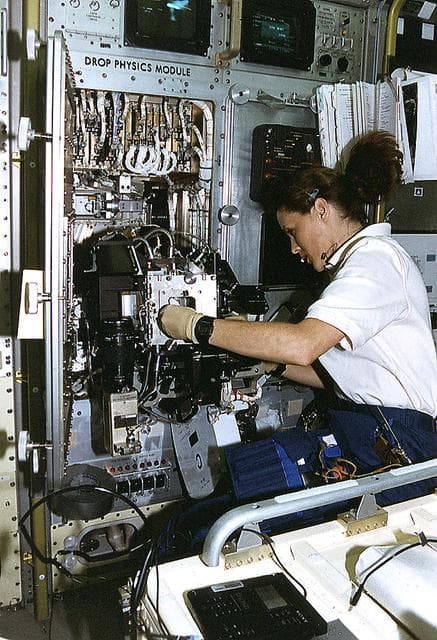
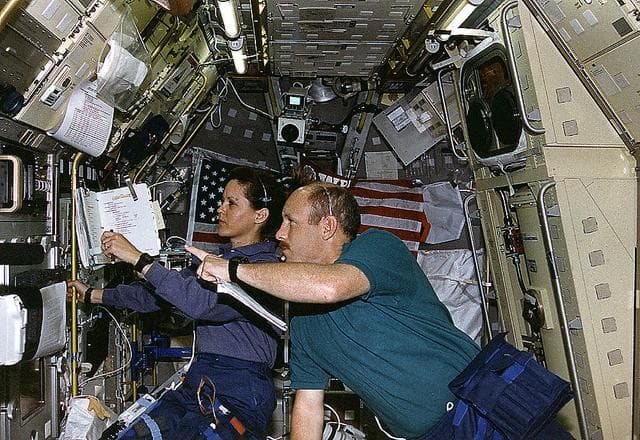
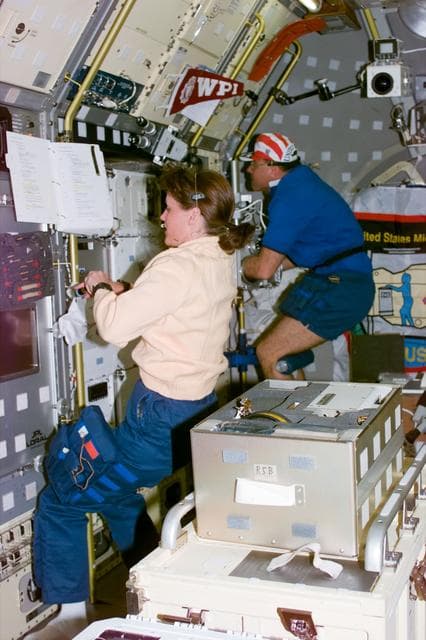
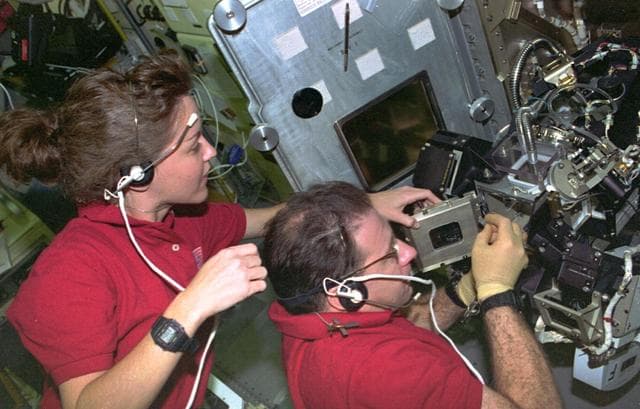
The first United States Microgravity Laboratory (USML-1) was one of NASA's science and technology programs that provided scientists an opportunity to research various scientific investigations in a weightlessness environment inside the Spacelab module. It also provided demonstrations of new equipment to help prepare for advanced microgravity research and processing aboard the Space Station. The USML-1 flew in orbit for extended periods, providing greater opportunities for research in materials science, fluid dynamics, biotechnology (crystal growth), and combustion science. This is a close-up view of the Drop Physics Module (DPM) in the USML science laboratory. The DPM was dedicated to the detailed study of the dynamics of fluid drops in microgravity: their equilibrium shapes, the dynamics of their flows, and their stable and chaotic behaviors. It also demonstrated a technique known as containerless processing. The DPM and microgravity combine to remove the effects of the container, such as chemical contamination and shape, on the sample being studied. Sound waves, generating acoustic forces, were used to suspend a sample in microgravity and to hold a sample of free drops away from the walls of the experiment chamber, which isolated the sample from potentially harmful external influences. The DPM gave scientists the opportunity to test theories of classical fluid physics, which have not been confirmed by experiments conducted on Earth. This image is a close-up view of the DPM. The USML-1 flew aboard the STS-50 mission on June 1992, and was managed by the Marshall Space Flight Center.
Usage Rights
Most NASA images are in the public domain and free to use. Credit NASA as the source. Check NASA's media usage guidelines for details. Images featuring identifiable individuals may require additional permissions.
Details
NASA ID
9300978
Date Created
June 1, 1992
Center
MSFC
Media Type
image
Downloads
Download this image in multiple resolutions. All NASA media are free for public use.