History of Hubble Space Telescope (HST)
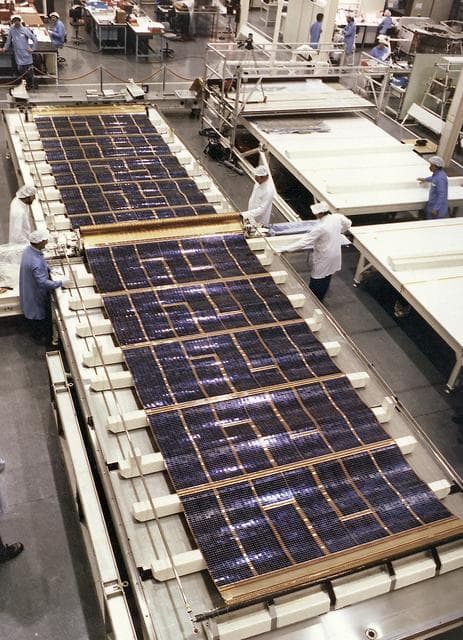
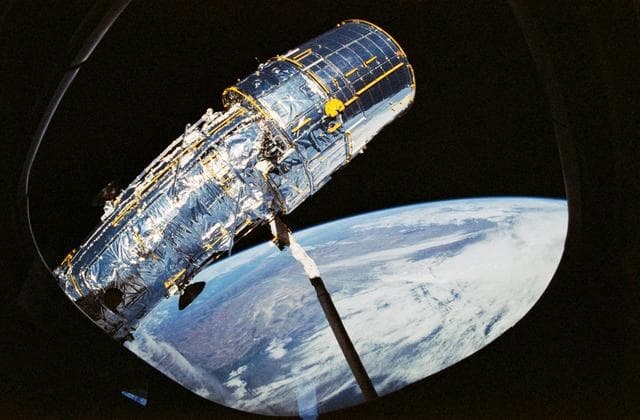
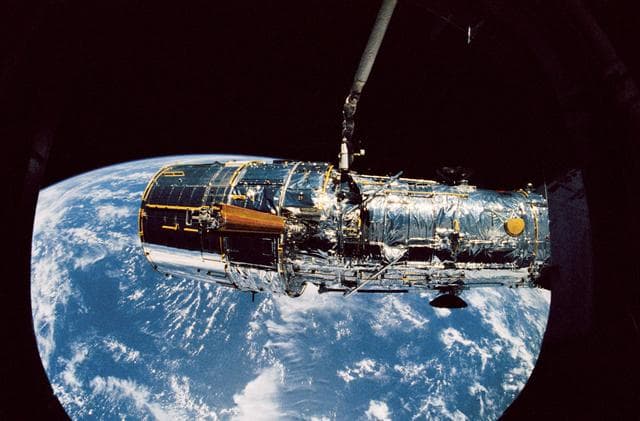
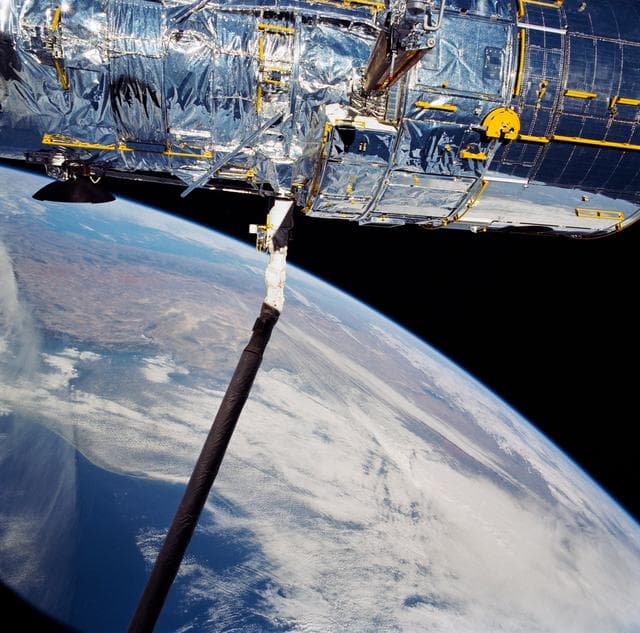
Engineers and technicians conduct a fit check of the Hubble Space Telescope (HST) Solar Array flight article in a clean room of the Lockheed Missile and Space Company. The Solar Array is 40- feet (12.1-meters) long and 8.2-feet (2.5-meters) wide, and provides power to the spacecraft. The HST is the first of NASA's great observatories and the most complex and sensitive optical telescope ever made. The purpose of the HST is to study the cosmos from a low-Earth orbit by placing the telescope in space, enabling astronomers to collect data that is free of the Earth's atmosphere. The HST was deployed from the Space Shuttle Discovery (STS-31 mission) into Earth orbit in April 1990. The Marshall Space Flight Center had overall responsibility for design, development, and construction of the HST. The Perkin-Elmer Corporation, in Danbury, Cornecticut, developed the optical system and guidance sensors. The Lockheed Missile and Space Company, Sunnyvale, California, produced the protective outer shroud and spacecraft systems, and assembled and tested the finished telescope.
Usage Rights
Most NASA images are in the public domain and free to use. Credit NASA as the source. Check NASA's media usage guidelines for details. Images featuring identifiable individuals may require additional permissions.
Details
NASA ID
8663403
Date Created
January 1, 1986
Center
MSFC
Media Type
image
Downloads
Download this image in multiple resolutions. All NASA media are free for public use.