This photograph shows Solid Rocket Booster segments undergoing stacking operations in Marshall Space Flight Center's Building 4707. The Solid Rocket Boosters were designed in-house at the Marshall Center with the Thiokol Corporation as the prime contractor.
Most NASA images are in the public domain and free to use. Credit NASA as the source. Check NASA's media usage guidelines for details. Images featuring identifiable individuals may require additional permissions.
NASA ID
7884995
Date Created
November 18, 1977
Center
MSFC
Media Type
image
Download this image in multiple resolutions. All NASA media are free for public use.
480px
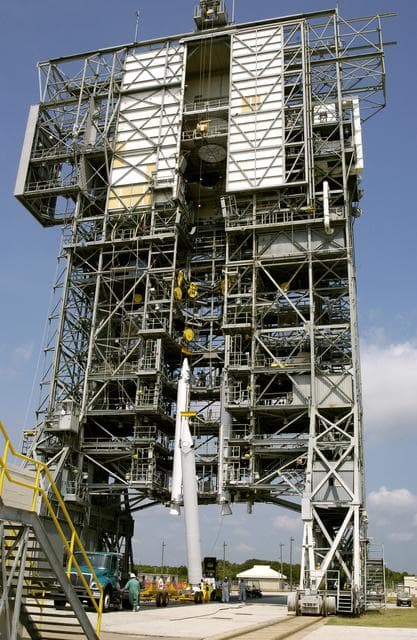
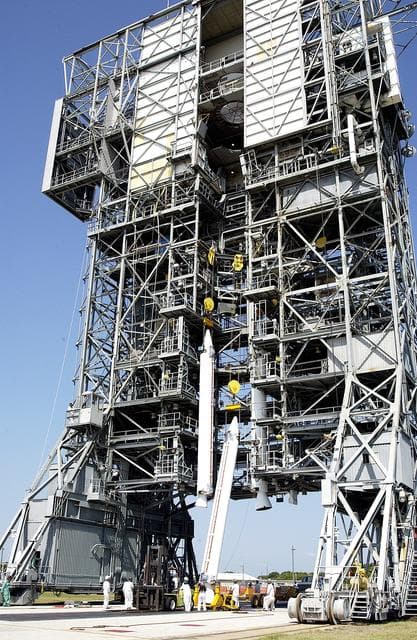
KENNEDY SPACE CENTER, FLA. - A third solid rocket booster (SRB) is lifted up the launch tower on Launch Complex 17-A, Cape Canaveral Air Force Station. They are three of nine SRBs that will be mated to the Delta rocket to launch Mars Exploration Rover 2. NASA’s twin Mars Exploration Rovers are designed to study the history of water on Mars. These robotic geologists are equipped with a robotic arm, a drilling tool, three spectrometers, and four pairs of cameras that allow them to have a human-like, 3D view of the terrain. Each rover could travel as far as 100 meters in one day to act as Mars scientists' eyes and hands, exploring an environment where humans can’t yet go. MER-2 is scheduled to launch June 5 as MER-A. MER-1 (MER-B) will launch June 25.
May 14, 2003
KENNEDY SPACE CENTER, FLA. - A third solid rocket booster (SRB) is lifted up the launch tower on Launch Complex 17-A, Cape Canaveral Air Force Station. They are three of nine SRBs that will be mated to the Delta rocket to launch Mars Exploration Rover 2 (MER-2). NASA’s twin Mars Exploration Rovers are designed to study the history of water on Mars. These robotic geologists are equipped with a robotic arm, a drilling tool, three spectrometers, and four pairs of cameras that allow them to have a human-like, 3D view of the terrain. Each rover could travel as far as 100 meters in one day to act as Mars scientists' eyes and hands, exploring an environment where humans can’t yet go. MER-2 is scheduled to launch June 5 as MER-A. MER-1 (MER-B) will launch June 25.
May 15, 2003
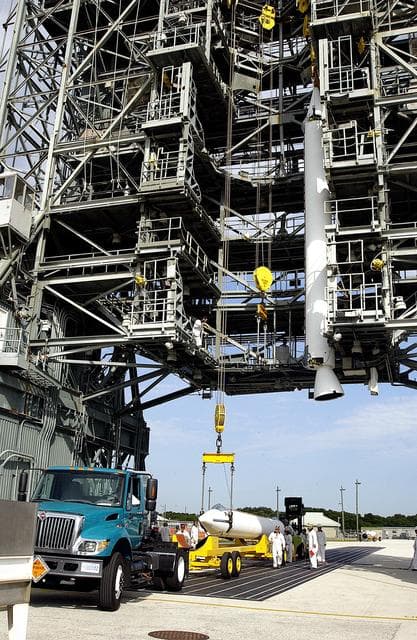
KENNEDY SPACE CENTER, FLA. - While one solid rocket booster (SRB) is suspended in the launch tower on Launch Complex 17-A, Cape Canaveral Air Force Station, another is raised from its transporter for a similar lift. They are two of nine SRBs that will be mated to the Delta rocket to launch Mars Exploration Rover 2. NASA’s twin Mars Exploration Rovers are designed to study the history of water on Mars. These robotic geologists are equipped with a robotic arm, a drilling tool, three spectrometers, and four pairs of cameras that allow them to have a human-like, 3D view of the terrain. Each rover could travel as far as 100 meters in one day to act as Mars scientists' eyes and hands, exploring an environment where humans can’t yet go. MER-2 is scheduled to launch June 5 as MER-A. MER-1 (MER-B) will launch June 25.
May 14, 2003
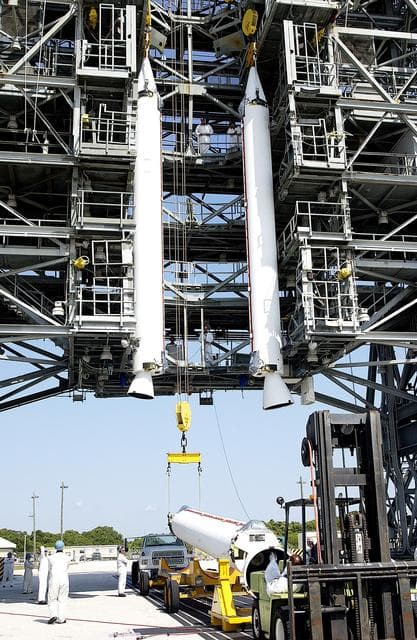
KENNEDY SPACE CENTER, FLA. - While two solid rocket boosters (SRBs) are suspended in the launch tower on Launch Complex 17-A, Cape Canaveral Air Force Station, another is being raised from its transporter for a similar lift. They are three of nine SRBs that will be mated to the Delta rocket to launch Mars Exploration Rover 2. NASA’s twin Mars Exploration Rovers are designed to study the history of water on Mars. These robotic geologists are equipped with a robotic arm, a drilling tool, three spectrometers, and four pairs of cameras that allow them to have a human-like, 3D view of the terrain. Each rover could travel as far as 100 meters in one day to act as Mars scientists' eyes and hands, exploring an environment where humans can’t yet go. MER-2 is scheduled to launch June 5 as MER-A. MER-1 (MER-B) will launch June 25.
May 14, 2003