Skylab
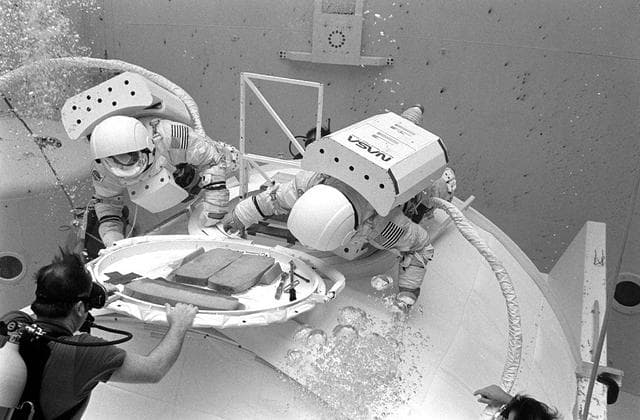
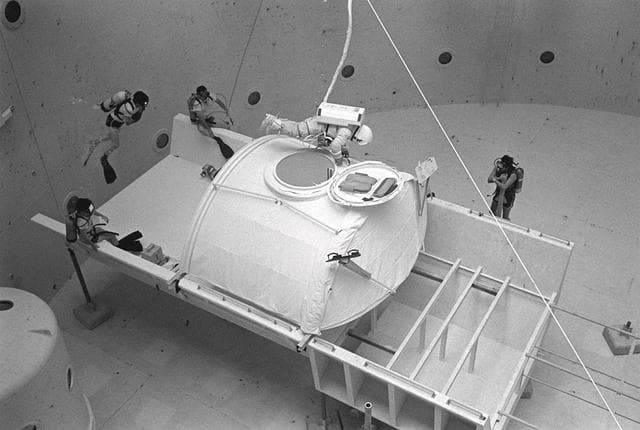
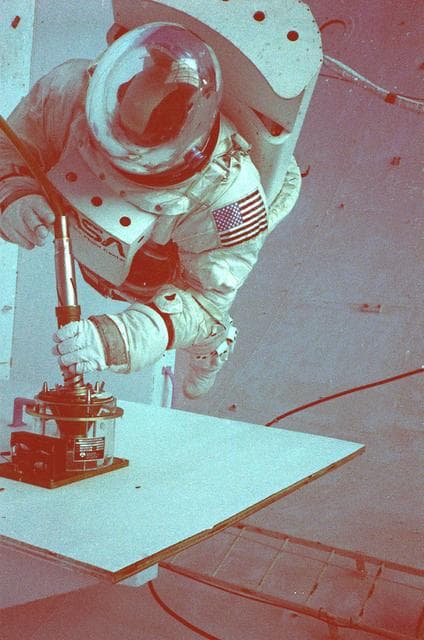
After the end of the Apollo missions, NASA's next adventure into space was the marned spaceflight of Skylab. Using an S-IVB stage of the Saturn V launch vehicle, Skylab was a two-story orbiting laboratory, one floor being living quarters and the other a work room. The objectives of Skylab were to enrich our scientific knowledge of the Earth, the Sun, the stars, and cosmic space; to study the effects of weightlessness on living organisms, including man; to study the effects of the processing and manufacturing of materials utilizing the absence of gravity; and to conduct Earth resource observations. At the Marshall Space Flight Center (MSFC), astronauts and engineers spent hundreds of hours in an MSFC Neutral Buoyancy Simulator (NBS) rehearsing procedures to be used during the Skylab mission, developing techniques, and detecting and correcting potential problems. The NBS was a 40-foot deep water tank that simulated the weightlessness environment of space. This photograph shows astronaut Ed Gibbon (a prime crew member of the Skylab-4 mission) during the neutral buoyancy Skylab extravehicular activity training at the Apollo Telescope Mount (ATM) mockup. One of Skylab's major components, the ATM was the most powerful astronomical observatory ever put into orbit to date.
Usage Rights
Most NASA images are in the public domain and free to use. Credit NASA as the source. Check NASA's media usage guidelines for details. Images featuring identifiable individuals may require additional permissions.
Details
NASA ID
7013601
Date Created
November 18, 1970
Center
MSFC
Media Type
image
Downloads
Download this image in multiple resolutions. All NASA media are free for public use.