KSC-05pd-0007
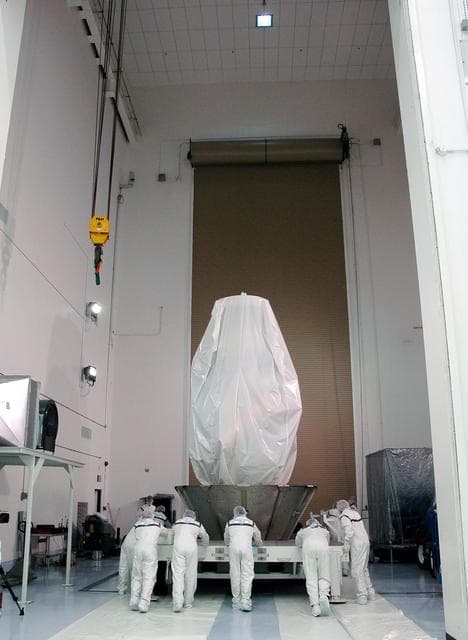
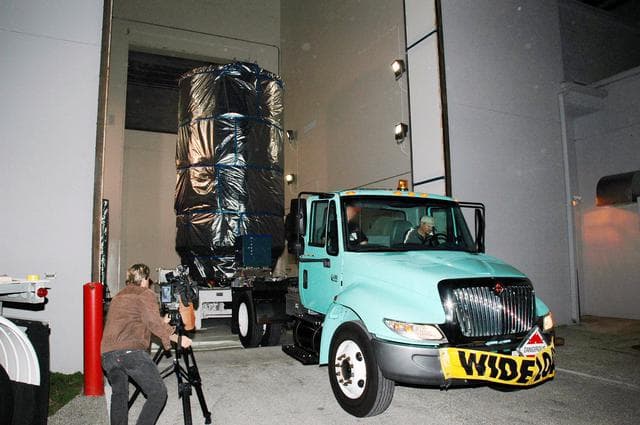
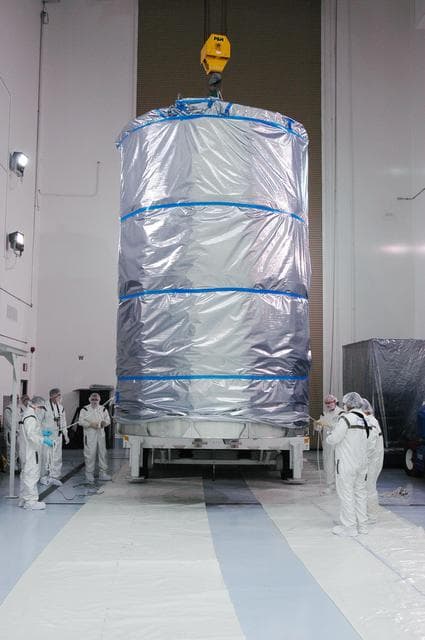
KENNEDY SPACE CENTER, FLA. - At Astrotech Space Operations in Titusville, Fla., technicians lower the upper canister toward the Deep Impact spacecraft. It will be attached to the lower segments already surrounding the spacecraft. Once the spacecraft is completely covered, it will be transferred to Launch Pad 17-B on Cape Canaveral Air Force Station, Fla. Then, in the mobile service tower, the fairing will be installed around the spacecraft. The fairing is a molded structure that fits flush with the outside surface of the Delta II upper stage booster and forms an aerodynamically smooth joint, protecting the spacecraft during launch. Scheduled for liftoff Jan. 12, Deep Impact will probe beneath the surface of Comet Tempel 1 on July 4, 2005, when the comet is 83 million miles from Earth. After releasing a 3- by 3-foot projectile to crash onto the surface, Deep Impact’s flyby spacecraft will reveal the secrets of its interior by collecting pictures and data of how the crater forms, measuring the crater’s depth and diameter as well as the composition of the interior of the crater and any material thrown out, and determining the changes in natural outgassing produced by the impact. It will send the data back to Earth through the antennas of the Deep Space Network. Deep Impact is a NASA Discovery mission.
Usage Rights
Most NASA images are in the public domain and free to use. Credit NASA as the source. Check NASA's media usage guidelines for details. Images featuring identifiable individuals may require additional permissions.
Details
NASA ID
05pd0007
Date Created
January 2, 2005
Center
KSC
Media Type
image
Photographer
NASA or National Aeronautics and Space Administration
Downloads
Download this image in multiple resolutions. All NASA media are free for public use.