Around Marshall
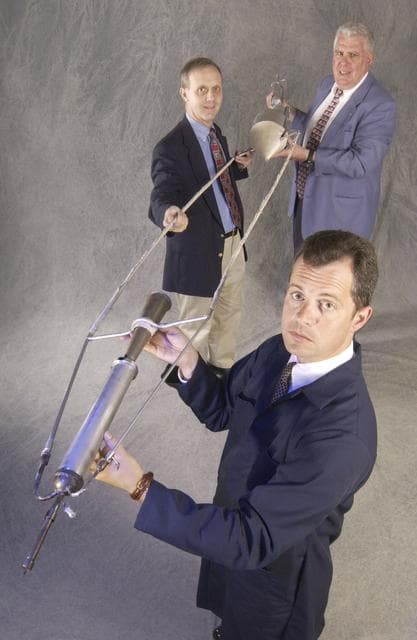
In honor of the Centernial of Flight Celebration and commissioned by the American Institute of Aeronautics and Astronautics (AIAA), a team of engineers from Marshall Space Flight Center (MSFC) built a replica of the first liquid-fueled rocket. The original rocket, designed and built by rocket engineering pioneer Robert H. Goddard in 1926, opened the door to modern rocketry. Goddard's rocket reached an altitude of 41 feet while its flight lasted only 2.5 seconds. The Marshall design team's plan was to stay as close as possible to an authentic reconstruction of Goddard's rocket. The same propellants were used - liquid oxygen and gasoline - as available during Goddard's initial testing and firing. The team also tried to construct the replica using the original materials and design to the greatest extent possible. By purposely using less advanced techniques and materials than many that are available today, the team encountered numerous technical challenges in testing the functional hardware. There were no original blueprints or drawings, only photographs and notes. However, this faithful adherence to historical accuracy has allowed the team to experience many of the same challenges Goddard faced 77 years ago, and more fully appreciate the genius of this extraordinary man. In this photo, the replica is shown firing in the A-frame launch stand in near-flight configuration at MSFC's Test Area 116 during the American Institute of Aeronautics and Astronautics 39th Joint Propulsion Conference on July 23, 2003.
Usage Rights
Most NASA images are in the public domain and free to use. Credit NASA as the source. Check NASA's media usage guidelines for details. Images featuring identifiable individuals may require additional permissions.
Keywords
Details
NASA ID
0301659
Date Created
July 23, 2003
Center
MSFC
Media Type
image
Downloads
Download this image in multiple resolutions. All NASA media are free for public use.