Space Science
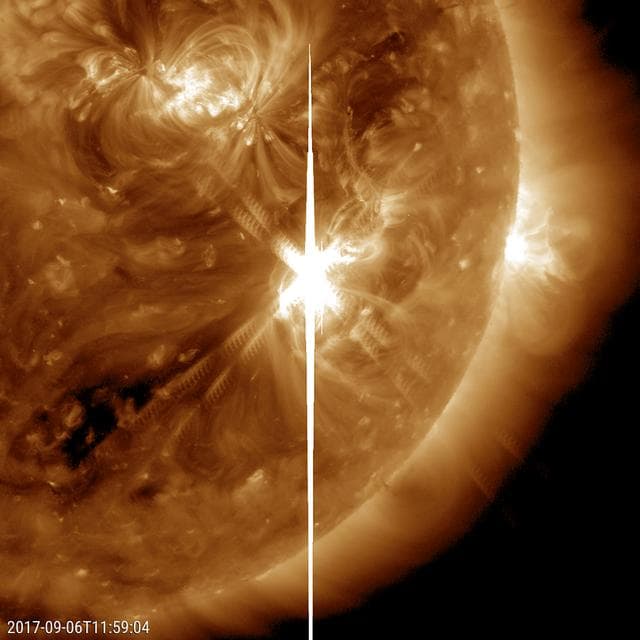
The largest solar flare ever recorded occurred at 4:51 p.m. EDT, on Monday, April 2, 2001. as Observed by the Solar and Heliospheric Observatory (SOHO) satellite. Solar flares, among the solar systems mightiest eruptions, are tremendous explosions in the atmosphere of the Sun capable of releasing as much energy as a billion megatons of TNT. Caused by the sudden release of magnetic energy, in just a few seconds, solar flares can accelerate solar particles to very high velocities, almost to the speed of light, and heat solar material to tens of millions of degrees. The recent explosion from the active region near the sun's northwest limb hurled a coronal mass ejection into space at a whopping speed of roughly 7.2 million kilometers per hour. Luckily, the flare was not aimed directly towards Earth. Second to the most severe R5 classification of radio blackout, this flare produced an R4 blackout as rated by the NOAA SEC. This classification measures the disruption in radio communications. Launched December 2, 1995 atop an ATLAS-IIAS expendable launch vehicle, the SOHO is a cooperative effort involving NASA and the European Space Agency (ESA). (Image courtesy NASA Goddard SOHO Project office)
Usage Rights
Most NASA images are in the public domain and free to use. Credit NASA as the source. Check NASA's media usage guidelines for details. Images featuring identifiable individuals may require additional permissions.
Keywords
Details
NASA ID
0300802
Date Created
April 2, 2001
Center
MSFC
Media Type
image
Downloads
Download this image in multiple resolutions. All NASA media are free for public use.