International Space Station (ISS)
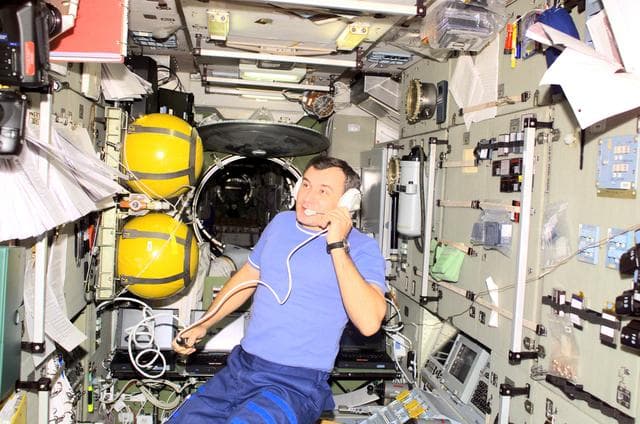
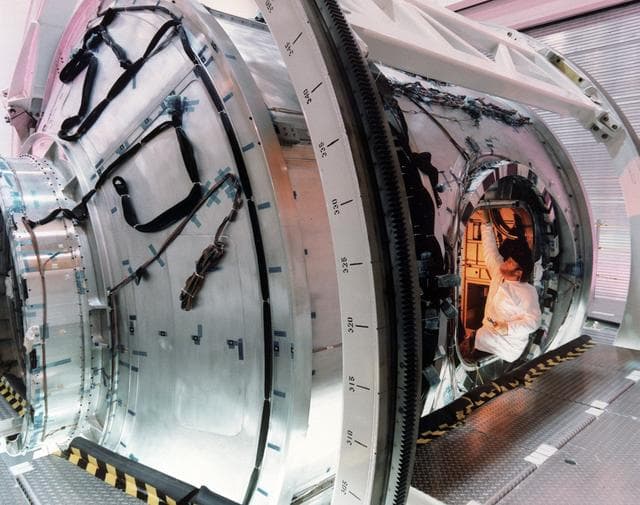
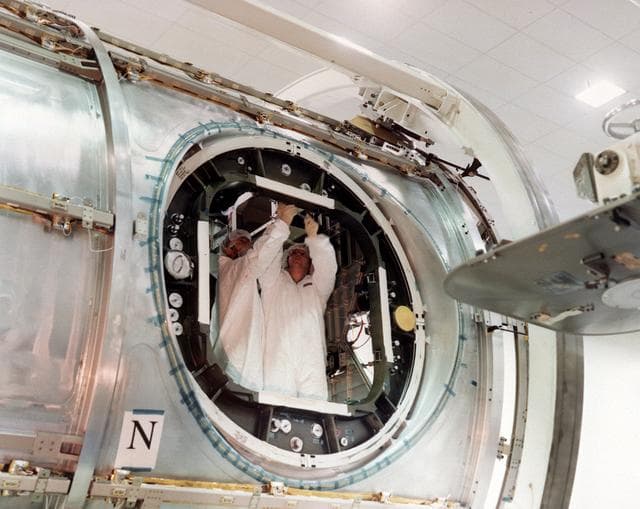
Cosmonaut Yuri P. Gidzenko, Expedition One Soyuz commander, stands near the hatch leading from the Unity node into the newly-attached Destiny laboratory aboard the International Space Station (ISS). The Node 1, or Unity, serves as a cornecting passageway to Space Station modules. The U.S.-built Unity module was launched aboard the Orbiter Endeavour (STS-88 mission) on December 4, 1998, and connected to Zarya, the Russian-built Functional Cargo Block (FGB). The U.S. Laboratory (Destiny) module is the centerpiece of the ISS, where science experiments will be performed in the near-zero gravity in space. The Destiny Module was launched aboard the Space Shuttle Orbiter Atlantis (STS-98 mission) on February 7, 2001. The aluminum module is 8.5 meters (28 feet) long and 4.3 meters (14 feet) in diameter. The laboratory consists of three cylindrical sections and two endcones with hatches that will be mated to other station components. A 50.9-centimeter- (20-inch-) diameter window is located on one side of the center module segment. This pressurized module is designed to accommodate pressurized payloads. It has a capacity of 24 rack locations, and payload racks will occupy 13 locations especially designed to support experiments.
Usage Rights
Most NASA images are in the public domain and free to use. Credit NASA as the source. Check NASA's media usage guidelines for details. Images featuring identifiable individuals may require additional permissions.
Details
NASA ID
0202503
Date Created
February 10, 2001
Center
MSFC
Media Type
image
Downloads
Download this image in multiple resolutions. All NASA media are free for public use.