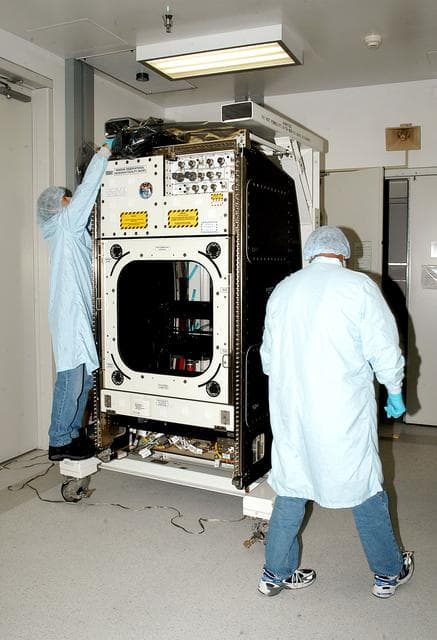
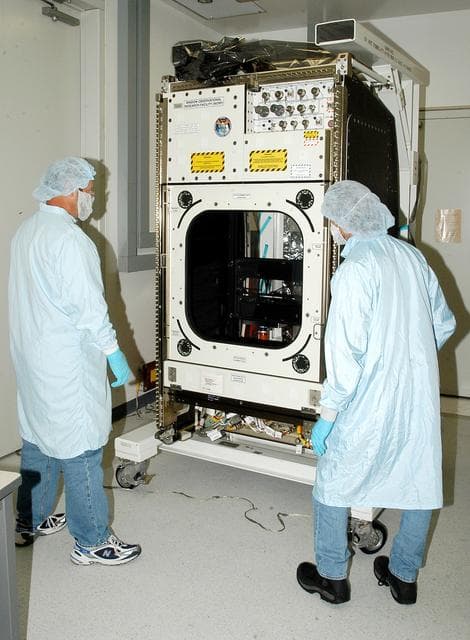
Developed by Boeing, at the Marshall Space Flight Center (MSFC) Space Station Manufacturing building, the Window Observational Rack Facility (WORF) will help Space Station crews take some of the best photographs ever snapped from an orbiting spacecraft by eliminating glare and allowing researchers to control their cameras and other equipment from the ground. The WORF is designed to make the best possible use of the high-quality research window in the Space Station's U.S. Destiny laboratory module. Engineers at the MSFC proposed a derivative of the EXPRESS (Expedite the Processing of Experiments to the Space Station) Rack already used on the Space Station and were given the go-ahead. The EXPRESS rack can hold a wide variety of experiments and provide them with power, communications, data, cooling, fluids, and other utilities - all the things that Earth-observing experiment instruments would need. WORF will supply payloads with power, data, cooling, video downlink, and stable, standardized interfaces for mounting imaging instruments. Similar to specialized orbital observatories, the interior of the rack is sealed against light and coated with a special low-reflectant black paint, so payloads will be able to observe low-light-level subjects such as the faint glow of auroras. Cameras and remote sensing instruments in the WORF can be preprogrammed, controlled from the ground, or operated by a Station crewmember by using a flexible shroud designed to cinch tightly around the crewmember's waist. The WORF is scheduled to be launched aboard the STS-114 Space Shuttle mission in the year 2003.
Most NASA images are in the public domain and free to use. Credit NASA as the source. Check NASA's media usage guidelines for details. Images featuring identifiable individuals may require additional permissions.
NASA ID
0201494
Date Created
May 28, 2002
Center
MSFC
Media Type
image
Download this image in multiple resolutions. All NASA media are free for public use.
1920px
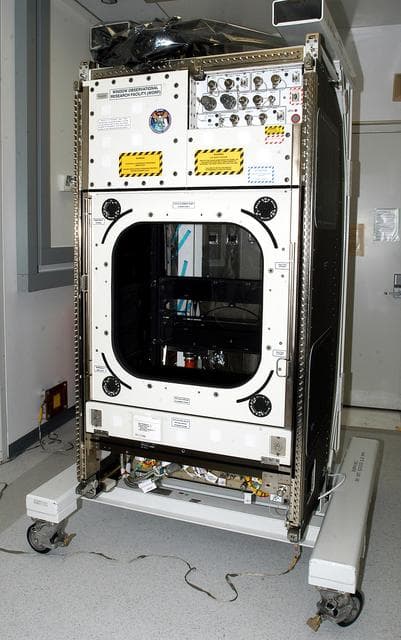
KENNEDY SPACE CENTER, FLA. - The Window Observational Research Facility (WORF), seen in the Space Station Processing Facility, was designed and built by the Boeing Co. at NASA’s Marshall Space Flight Center in Huntsville, Ala. WORF will be delivered to the International Space Station and placed in the rack position in front of the Destiny lab window, providing locations for attaching cameras, multi-spectral scanners and other instruments. WORF will support a variety of scientific and commercial experiments in areas of Earth systems and processes, global ecological changes in Earth’s biosphere, lithosphere, hydrosphere and climate system, Earth resources, natural hazards, and education. After installation, it will become a permanent focal point for Earth Science research aboard the space station.
Sep 8, 2003
KENNEDY SPACE CENTER, FLA. - Workers in the Space Station Processing Facility check out the Window Observational Research Facility (WORF), designed and built by the Boeing Co. at NASA’s Marshall Space Flight Center in Huntsville, Ala. WORF will be delivered to the International Space Station and placed in the rack position in front of the Destiny lab window, providing locations for attaching cameras, multi-spectral scanners and other instruments. WORF will support a variety of scientific and commercial experiments in areas of Earth systems and processes, global ecological changes in Earth’s biosphere, lithosphere, hydrosphere and climate system, Earth resources, natural hazards, and education. After installation, it will become a permanent focal point for Earth Science research aboard the space station.
Sep 8, 2003
KENNEDY SPACE CENTER, FLA. - Workers in the Space Station Processing Facility check out the Window Observational Research Facility (WORF), designed and built by the Boeing Co. at NASA’s Marshall Space Flight Center in Huntsville, Ala. WORF will be delivered to the International Space Station and placed in the rack position in front of the Destiny lab window, providing locations for attaching cameras, multi-spectral scanners and other instruments. WORF will support a variety of scientific and commercial experiments in areas of Earth systems and processes, global ecological changes in Earth’s biosphere, lithosphere, hydrosphere and climate system, Earth resources, natural hazards, and education. After installation, it will become a permanent focal point for Earth Science research aboard the space station.
Sep 8, 2003
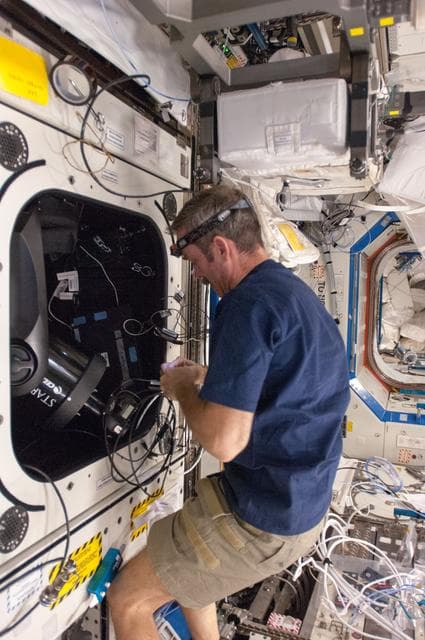
Hadfield works on the ISERV in the U.S. Laboratory
Jan 15, 2013