Pathfinder
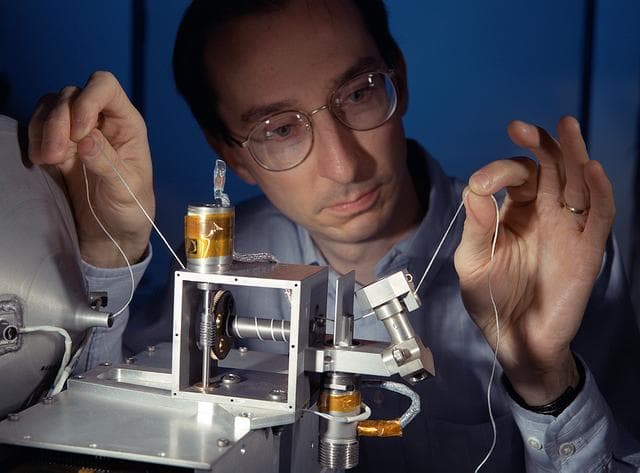
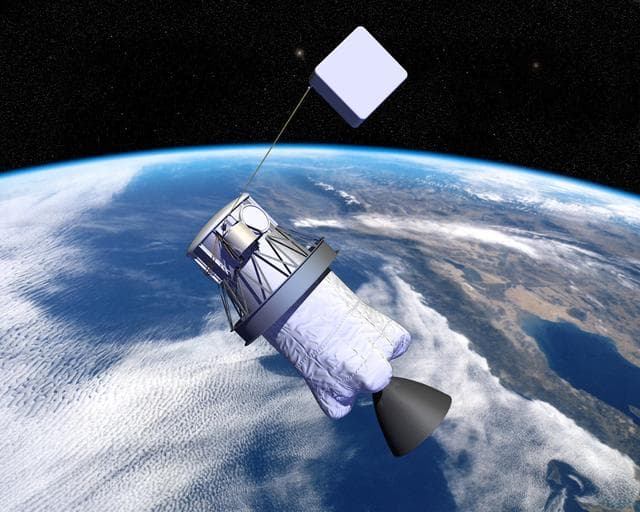
This photograph shows two Marshall Space Flight Center (MSFC) engineers, Mark Vaccaro (left) and Ken Welzyn, testing electrodynamic tethers in the MSFC Tether Winding and Spark Testing Facility. For 4 years, MSFC and industry partners have been developing the Propulsive Small Expendable Deployer System experiment, called ProSEDS. ProSEDS will test electrodynamic tether propulsion technology. Electrodynamic tethers are long, thin wires that collect electrical current when passing through a magnetic field. The tether works as a thruster as a magnetic field exerts a force on a current-carrying wire. Since electrodynamic tethers require no propellant, they could substantially reduce the weight of the spacecraft and provide a cost-effective method of reboosting spacecraft. The initial flight of ProSEDS is scheduled to fly aboard an Air Force Delta II rocket in the summer of 2002. In orbit, ProSEDS will deploy from a Delta II second stage. It will be a 3.1-mile (5 kilometer) long, ultrathin base-wire tether cornected with a 6.2-mile (10 kilometer) long non-conducting tether. This photograph shows Less Johnson, a scientist at MSFC, inspecting the nonconducting part of a tether as it exits a deployer similar to the one to be used in the ProSEDS experiment. The ProSEDS experiment is managed by the Space Transportation Directorate at MSFC.
Usage Rights
Most NASA images are in the public domain and free to use. Credit NASA as the source. Check NASA's media usage guidelines for details. Images featuring identifiable individuals may require additional permissions.
Details
NASA ID
0102634
Date Created
July 1, 2001
Center
MSFC
Media Type
image
Downloads
Download this image in multiple resolutions. All NASA media are free for public use.