Microgravity
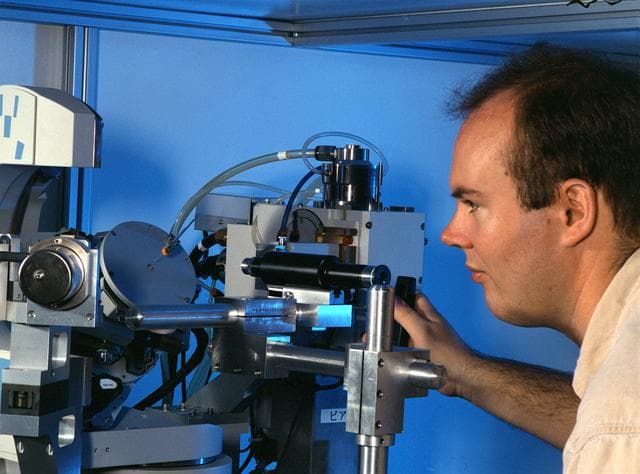
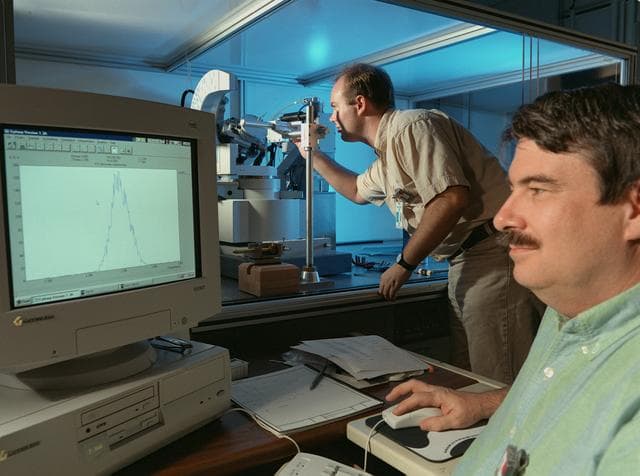
Atomic force microscopy uses laser technology to reveal a defect, a double-screw dislocation, on the surface of this crystal of canavalin, a major source of dietary protein for humans and domestic animals. When a crystal grows, attachment kinetics and transport kinetics are competing for control of the molecules. As a molecule gets close to the crystal surface, it has to attach properly for the crystal to be usable. NASA has funded investigators to look at those attachment kinetics from a theoretical standpoint and an experimental standpoint. Dr. Alex McPherson of the University of California, Irvine, is one of those investigators. He uses X-ray diffraction and atomic force microscopy in his laboratory to answer some of the many questions about how protein crystals grow. Atomic force microscopy provides a means of looking at how individual molecules are added to the surface of growing protein crystals. This helps McPherson understand the kinetics of protein crystal growth. McPherson asks, How fast do crystals grow? What are the forces involved? Investigators funded by NASA have clearly shown that such factors as the level of supersaturation and the rate of growth all affect the habit [characteristic arrangement of facets] of the crystal and the defects that occur in the crystal.
Usage Rights
Most NASA images are in the public domain and free to use. Credit NASA as the source. Check NASA's media usage guidelines for details. Images featuring identifiable individuals may require additional permissions.
Details
NASA ID
0101744
Date Created
June 6, 2001
Center
MSFC
Media Type
image
Downloads
Download this image in multiple resolutions. All NASA media are free for public use.