CosmosObservatory
Explore
Solar System
Live
Learn
Tools
About
Cosmos Observatory
ToolsAbout
Cosmos Observatory

Explore the universe through NASA data, real-time ISS tracking, Mars rover imagery, asteroid monitoring, and comprehensive space encyclopedia. Your gateway to the cosmos.

Explore

  • APOD
  • Mars Rovers
  • Earth Imagery
  • NASA Gallery
  • ISS Tracker

Data

  • Asteroids
  • Solar System
  • Exoplanets
  • Space Weather
  • Launches

Tools

  • Glossary
  • News
  • Calculators

Legal

  • About
  • Privacy Policy
  • Terms of Use
  • Space Tools
  • Contact

Stay updated with the cosmos

Get weekly digests of APOD highlights, upcoming launches, and space events.

© 2026 Cosmos Observatory. All rights reserved. Built with for space enthusiasts.

This website is not affiliated with, maintained, authorized, endorsed by, or in any way officially connected with NASA or any of its subsidiaries or affiliates. All NASA imagery is in the public domain unless otherwise noted. Data sourced from NASA Open APIs, Launch Library 2, and other open data services.

  1. Home
  2. APOD
  3. February 5, 2022
APOD

Symbiotic R Aquarii

February 5, 2022
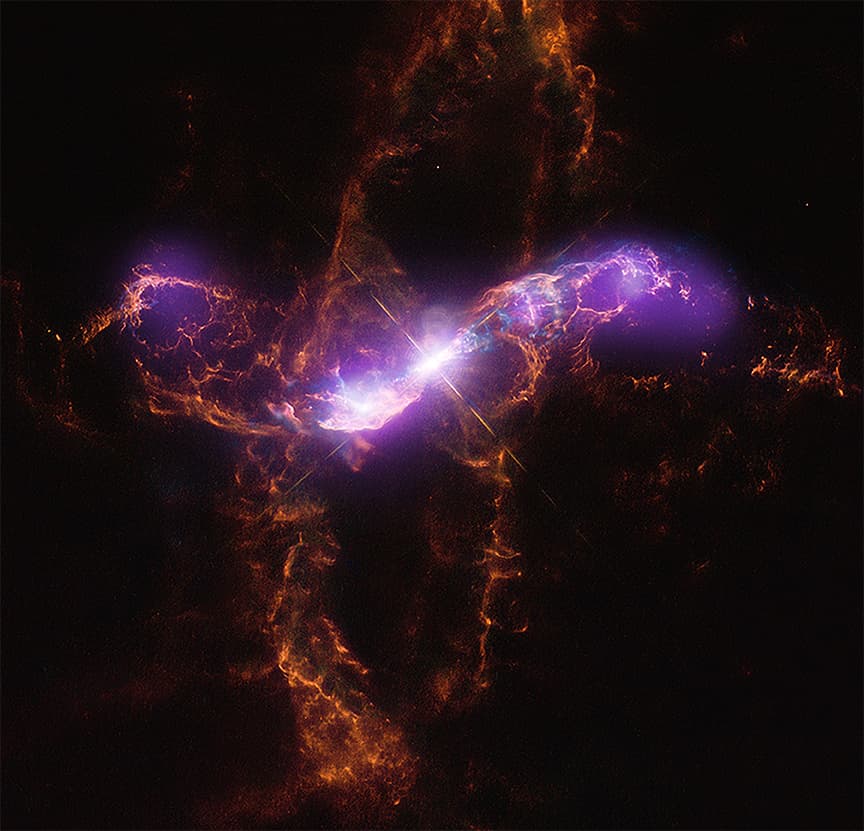
NASA APOD February 5, 2022: Symbiotic R AquariiFull Resolution
PreviousFebruary 4, 2022
Today
NextFebruary 6, 2022

About This Image

Variable star R Aquarii is actually an interacting binary star system, two stars that seem to have a close symbiotic relationship. Centered in this space-based optical/x-ray composite image it lies about 710 light years away. The intriguing system consists of a cool red giant star and hot, dense white dwarf star in mutual orbit around their common center of mass. With binoculars you can watch as R Aquarii steadily changes its brightness over the course of a year or so. The binary system's visible light is dominated by the red giant, itself a Mira-type long period variable star. But material in the cool giant star's extended envelope is pulled by gravity onto the surface of the smaller, denser white dwarf, eventually triggering a thermonuclear explosion, blasting material into space. Astronomers have seen such outbursts over recent decades. Evidence for much older outbursts is seen in these spectacular structures spanning almost a light-year as observed by the Hubble Space Telescope (in red and blue). Data from the Chandra X-ray Observatory (in purple) shows the X-ray glow from shock waves created as a jet from the white dwarf strikes surrounding material.

Share

Full Archive

Browse by month since 1995

Mars Rover Photos

Curiosity & Perseverance

NASA Gallery

140,000+ space images

More From the Archive

APOD: DART vs Dimorphos - March 9, 2023

March 9, 2023

DART vs Dimorphos

APOD: Stars and Dust across Corona Australis - June 22, 2023

June 22, 2023

Stars and Dust across Corona Australis

APOD: CG4: A Ruptured Cometary Globule - December 28, 1996

December 28, 1996

CG4: A Ruptured Cometary Globule

APOD: Probably a Planet for Beta Pic - November 28, 2008

November 28, 2008

Probably a Planet for Beta Pic

APOD: Messier 24: Sagittarius Star Cloud - June 29, 2018

June 29, 2018

Messier 24: Sagittarius Star Cloud

Today's APOD

View the latest picture

Full Archive

Since June 16, 1995

Exoplanet Explorer

5,700+ confirmed worlds