CosmosObservatory
Explore
Solar System
Live
Learn
Tools
About
Cosmos Observatory
ToolsAbout
Cosmos Observatory

Explore the universe through NASA data, real-time ISS tracking, Mars rover imagery, asteroid monitoring, and comprehensive space encyclopedia. Your gateway to the cosmos.

Explore

  • APOD
  • Mars Rovers
  • Earth Imagery
  • NASA Gallery
  • ISS Tracker

Data

  • Asteroids
  • Solar System
  • Exoplanets
  • Space Weather
  • Launches

Tools

  • Glossary
  • News
  • Calculators

Legal

  • About
  • Privacy Policy
  • Terms of Use
  • Space Tools
  • Contact

Stay updated with the cosmos

Get weekly digests of APOD highlights, upcoming launches, and space events.

© 2026 Cosmos Observatory. All rights reserved. Built with for space enthusiasts.

This website is not affiliated with, maintained, authorized, endorsed by, or in any way officially connected with NASA or any of its subsidiaries or affiliates. All NASA imagery is in the public domain unless otherwise noted. Data sourced from NASA Open APIs, Launch Library 2, and other open data services.

  1. Home
  2. APOD
  3. July 11, 2016
APOD

Aurorae on Jupiter

July 11, 2016
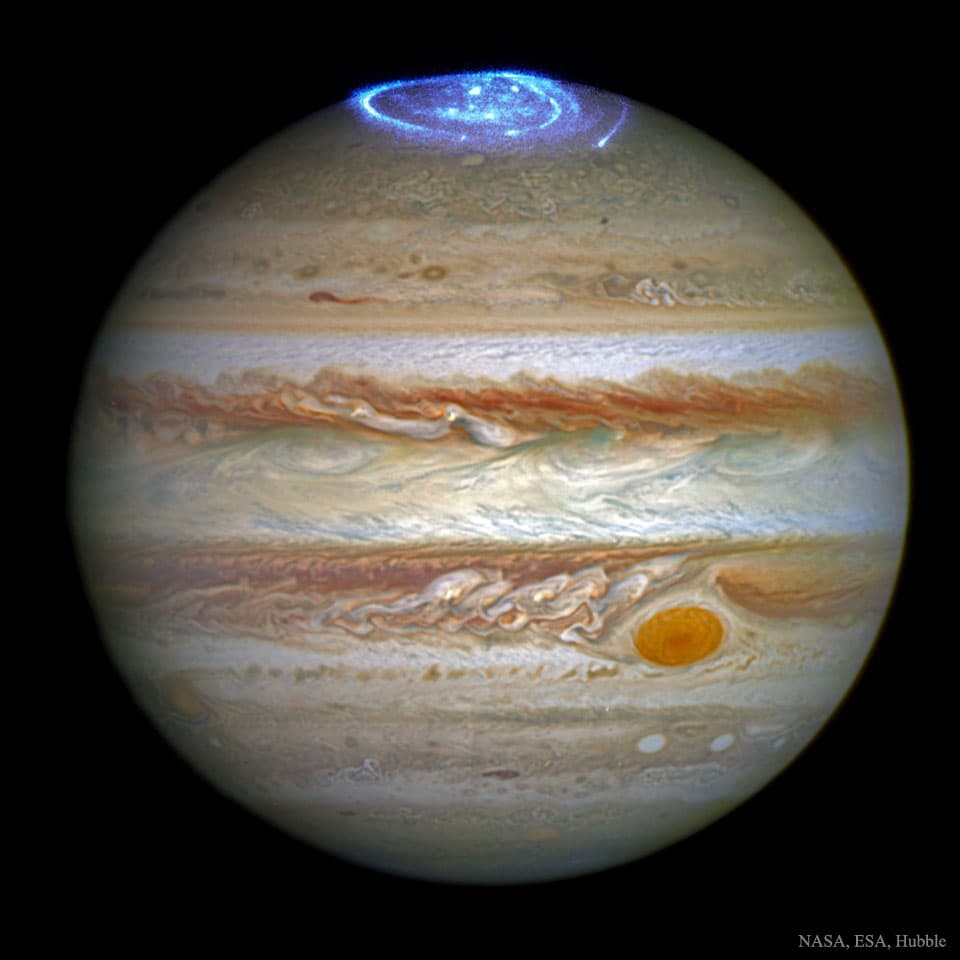
NASA APOD July 11, 2016: Aurorae on JupiterFull Resolution
PreviousJuly 10, 2016
Today
NextJuly 12, 2016

About This Image

Jupiter has aurorae. Like Earth, the magnetic field of the gas giant funnels charged particles released from the Sun onto the poles. As these particles strike the atmosphere, electrons are temporarily knocked away from existing gas molecules. Electric force attracts these electrons back. As the electrons recombine to remake neutral molecules, auroral light is emitted. In the featured recently released composite image by the Hubble Space Telescope taken in ultraviolet light, the aurorae appear as annular sheets around the pole. Unlike Earth's aurorae, Jupiter's aurorae include several bright streaks and dots. Jupiter's Great Red Spot is visible on the lower right. Recent aurorae on Jupiter have been particularly strong -- a fortunate coincidence with the arrival of NASA's Juno spacecraft at Jupiter last week. Juno was able to monitor the Solar Wind as it approached Jupiter, enabling a better understanding of aurorae in general, including on Earth.

Share

Full Archive

Browse by month since 1995

Mars Rover Photos

Curiosity & Perseverance

NASA Gallery

140,000+ space images

More From the Archive

APOD: Astro-2 In Orbit - March 17, 2001

March 17, 2001

Astro-2 In Orbit

APOD: Mapping Mars - March 19, 1999

March 19, 1999

Mapping Mars

APOD: Clouds of the Large Magellanic Cloud - May 3, 2019

May 3, 2019

Clouds of the Large Magellanic Cloud

APOD: Starburst Galaxy IC 10 - October 9, 2009

October 9, 2009

Starburst Galaxy IC 10

APOD: Giant Storm Systems Battle on Jupiter - February 5, 2002

February 5, 2002

Giant Storm Systems Battle on Jupiter

Today's APOD

View the latest picture

Full Archive

Since June 16, 1995

Exoplanet Explorer

5,700+ confirmed worlds