CosmosObservatory
Explore
Solar System
Live
Learn
Tools
About
Cosmos Observatory
ToolsAbout
Cosmos Observatory

Explore the universe through NASA data, real-time ISS tracking, Mars rover imagery, asteroid monitoring, and comprehensive space encyclopedia. Your gateway to the cosmos.

Explore

  • APOD
  • Mars Rovers
  • Earth Imagery
  • NASA Gallery
  • ISS Tracker

Data

  • Asteroids
  • Solar System
  • Exoplanets
  • Space Weather
  • Launches

Tools

  • Glossary
  • News
  • Calculators

Legal

  • About
  • Privacy Policy
  • Terms of Use
  • Space Tools
  • Contact

Stay updated with the cosmos

Get weekly digests of APOD highlights, upcoming launches, and space events.

© 2026 Cosmos Observatory. All rights reserved. Built with for space enthusiasts.

This website is not affiliated with, maintained, authorized, endorsed by, or in any way officially connected with NASA or any of its subsidiaries or affiliates. All NASA imagery is in the public domain unless otherwise noted. Data sourced from NASA Open APIs, Launch Library 2, and other open data services.

  1. Home
  2. APOD
  3. May 23, 2016
APOD

Inside a Daya Bay Antineutrino Detector

May 23, 2016DOE, Berkeley Lab - Roy Kaltschmidt, photographer
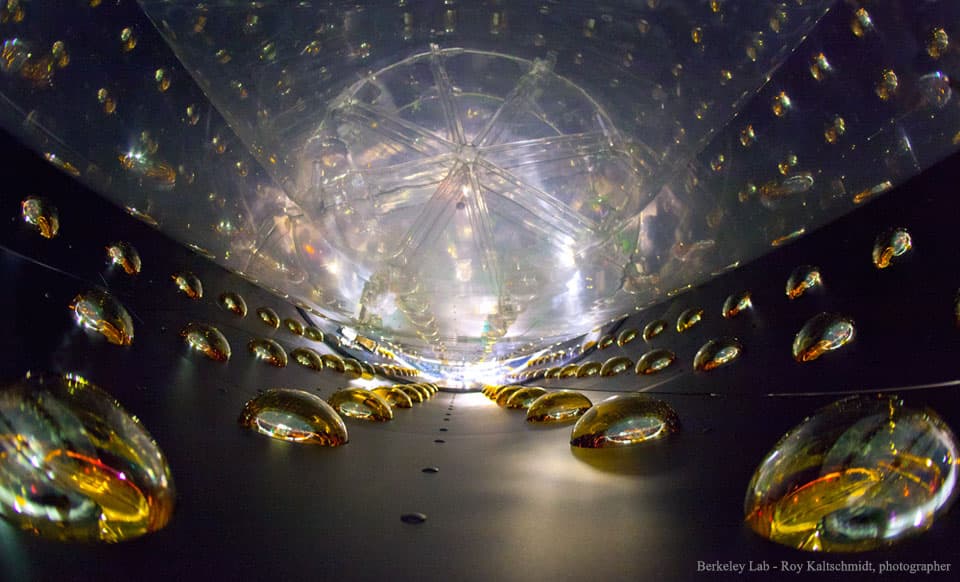
NASA APOD May 23, 2016: Inside a Daya Bay Antineutrino DetectorFull Resolution
PreviousMay 22, 2016
Today
NextMay 24, 2016

About This Image

Why is there more matter than antimatter in the Universe? To better understand this facet of basic physics, energy departments in China and the USA led in the creation of the Daya Bay Reactor Neutrino Experiment. Located under thick rock about 50 kilometers northeast of Hong Kong, China, eight Daya Bay detectors monitor antineutrinos emitted by six nearby nuclear reactors. Featured here, a camera looks along one of the Daya Bay detectors, imaging photon sensors that pick up faint light emitted by antineutrinos interacting with fluids in the detector. Early results indicate an unexpectedly high rate of one type of antineutrino changing into another, a rate which, if confirmed, could imply the existence of a previously undetected type of neutrino as well as impact humanity's comprehension of fundamental particle reactions that occurred within the first few seconds of the Big Bang. Astrophysicists: Browse 1,250+ codes in the Astrophysics Source Code Library

Share

Full Archive

Browse by month since 1995

Mars Rover Photos

Curiosity & Perseverance

NASA Gallery

140,000+ space images

More From the Archive

Today's APOD

View the latest picture

Full Archive

Since June 16, 1995

Exoplanet Explorer

5,700+ confirmed worlds